TONIGHT: Ojai City Council to Discuss the Permanent Supportive Housing Project Formerly Known as "Cabin Village"
$12.7 million for homeless housing in Ojai, two years later. And assorted updates.

Greetings Readers!
First, I want to thank the readers who joined me for the 4th Local Hero Subscriber Happy Hour at the Ojai Valley Brewery March 16th. It’s always a gathering of a diverse, interesting bunch of folks with a shared interest in democracy. What’s cooler?!
Second, as you know, I enlisted your help in selecting my next story topic. Hilariously, there was a tie.

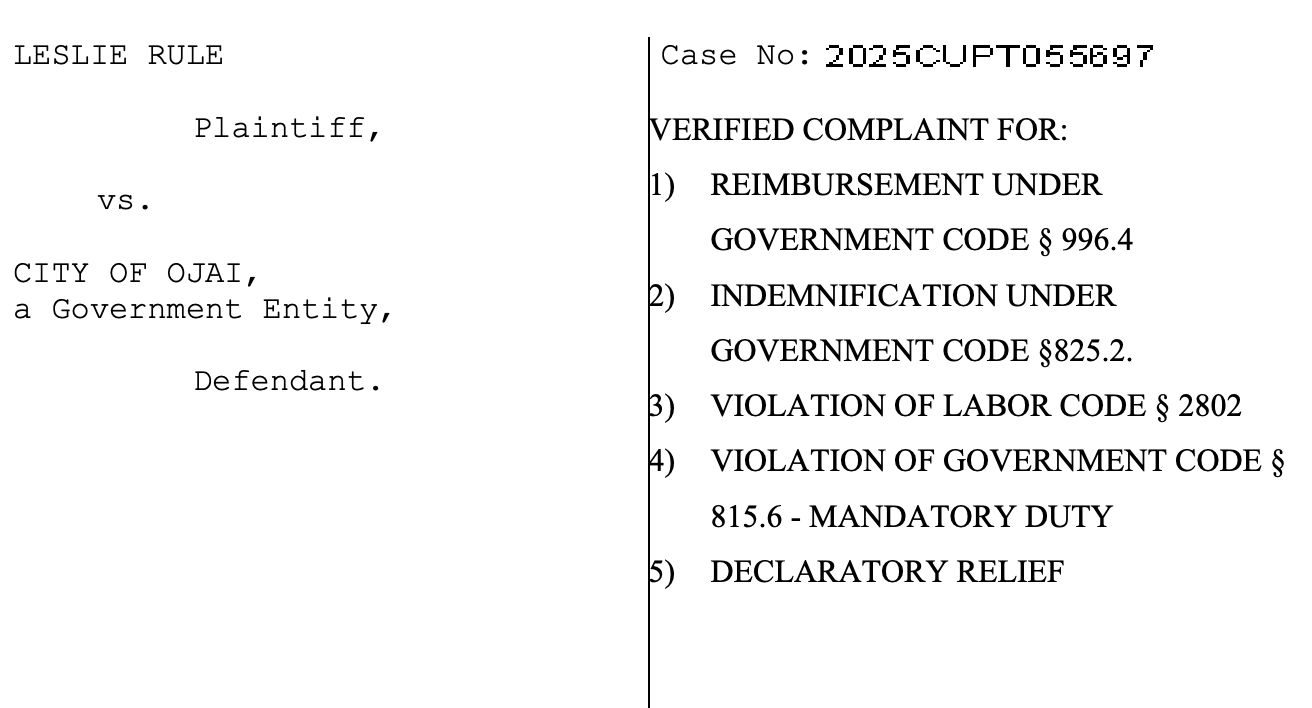
I decided that now is the time to dig into Councilwoman Leslie Rule’s legal saga. In short, a 2023 lawsuit against Rule brought by seven Ojai residents (Byrne et. al. v. Rule et. al.) has sparked Rule’s own suit against the City of Ojai for legal fees, or indemnification.
It’s a hell of a project. Like pickleball, but worse. It’s also a very important story about governance, the politics of housing, and the City of Ojai’s legal budget.
But that’s not what I’m writing about today!1
I’m coming out of my writing hole with an update on the other side of that tie vote: the people of Ojai Tent Town (OTT) and the City of Ojai’s $12.7 million state-funded permanent supportive housing project to house them.
Why? Because the Ojai City Council will discuss and take action that could alter the project’s future during tonight’s meeting (March 24th at 6pm).
If you’re interested in the history of Ojai Tent Town, I encourage you to check out my past reports.2 I’ll also remind you that City Council meetings are broadcast live on YouTube.
The Ojai City Council and the project formerly known as “Cabin Village.”
One last bit of context before we run through a few of the Council’s March 24th agenda items, check in at OTT, and review some fresh data: we’re approaching the second anniversary of Ojai’s Encampment Resolution Funding (ERF) grant award.

Onward to the meeting agenda — this is going to be a long one, folks. And while there are plenty(!) of interesting topics on the agenda, we’re going to focus on the 30-unit permanent supportive housing project formerly known as Cabin Village.
First: there’s a newly proposed location. (There have been many.)
If you keep up with me on social media, you’ll know that the Council voted to purchase an $850,000 single-family home adjacent to Ojai City Hall during their March 10th meeting. (Mayor Andy Gilman and Councilmembers Rachel Lang and Leslie Rule voted for the purchase; Councilmembers Andy Whitman and Kim Mang voted in opposition.)
During the March 10th discussion, Rule called for a city staff-led feasibility study regarding the potential to move the 30-unit permanent supportive housing project (currently sited at the City’s public works yard) to the .2 acre parcel. Rule added, “I think the maintenance yard is failing,” and “I am losing confidence in Dignity Moves (the developer) all the time.” The March 24th agenda features the results of that review.

In short, City staff do not recommend the move. “The attached feasibility review document concludes that… developing the property at 503 S. Ventura Street for a 31-unit permanent supportive housing project is not recommended.”3
Important political background: historically, Gilman, Lang, and Rule make up the Council majority in favor of the housing project. Mang and Whitman have historically voted in opposition. Rule’s dissension is something to watch.
Onward to the next ERF-related agenda item — another request originating from the Mach 10th meeting: a summary of Dignity Moves expenditures utilizing ERF grant funds through January 2026. According to a City staff report, monthly Dignity Moves progress reports will be posted here, following the March 24th meeting.

There’s more, folks! The Council will next review its development management agreement with Dignity Moves, which was approved by a Council majority on May 27, 2025. (Gilman, Lang, and Rule voted “yes”; Mang and Whitman voted “no.”) The agreement provides Dignity Moves a construction budget of $9.5 million and a management fee of $500,000. City staff prepared a six-page question-and-answer document for the discussion.

Stick with me folks — there’s one more relevant agenda item! Does anyone remember the “dirt of unknown origin” at the City’s public works yard? City staff have proposed the Council sign a contract with Pacific Petroleum California, Inc to remove arsenic and lead-impacted soil from the future housing site. In total, the removal process is estimated to cost just over $160,000 to be funded by the ERF grant, according to a City staff report.
And that, my friends, is that.
Now, let’s check in on the people of Ojai Tent Town — the folks hoping to make their homes in this housing project — some of whom have been living at Ojai City Hall for going on three years.
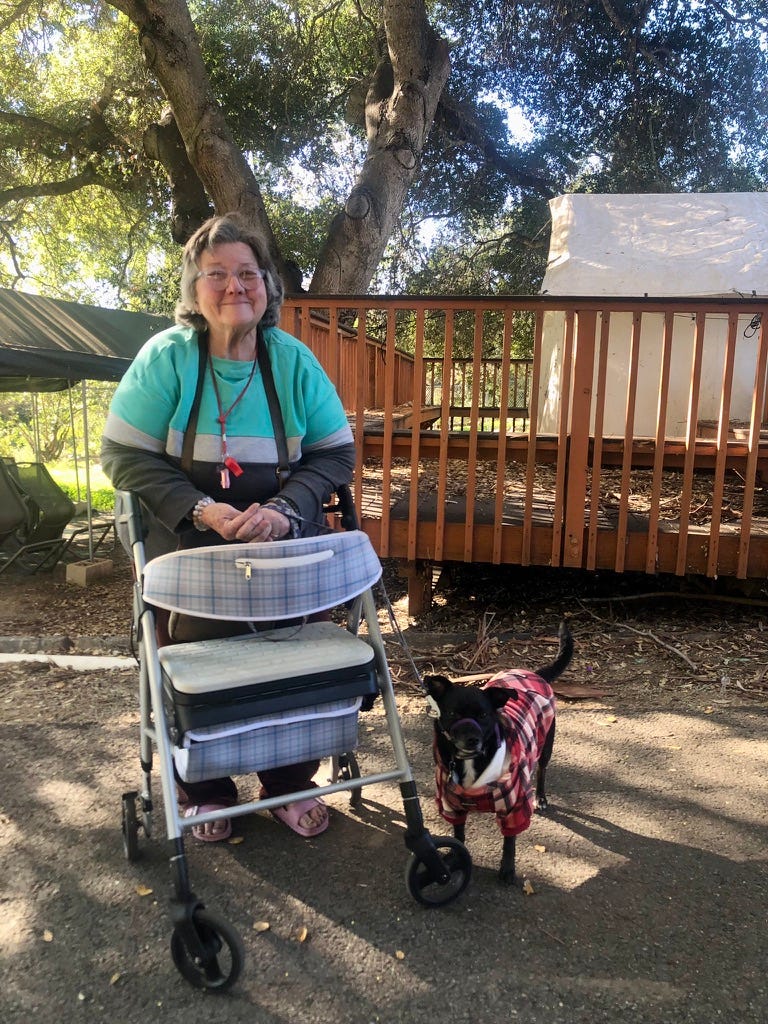
Checking in at Ojai Tent Town

“We’re not ready for it to be hot right now,” Ojai Tent Town volunteer Ruth Miller remarked during the mid-March heat wave. “Some of the swamp coolers have died, and so we had people without swamp coolers in their tents — the full sun blasting.” Temperatures inside residents’ tents, Miller said, approached 113 degrees in the unseasonable heat. About half of OTT residents do have access to “minimal” solar electricity, thanks to donated solar panels maintained by resident William Holden, Miller said.
Shared air conditioning is available on site in OTT’s “coffee room” — though I’d estimate the space doesn’t fit more than 6 people comfortably at one time. The Ojai Library is the next-best option, roughly 0.3 miles from OTT. One OTT resident I chatted with on March 13th said she was keeping cool by periodically wetting her hair with an on-site hose.
In addition to the extreme heat, OTT residents are battling a rodent infestation. One resident was bitten in the face by a rat, Miller said. Another resident told me that their dog suffered a rat bite.
Many OTT residents are elderly and medically vulnerable, Miller reminded me.
“We have people with heart disease. We have people with an aortic aneurysm. We have people living here with cancer… we’ve got a guy with one leg… We’ve got older people who are trying to survive… One of our participants has fallen and [been] hospitalized three times in the last few months.”
Two other OTT residents have shared they live with seizures.
Miller was part of the team of volunteers who encouraged the City of Ojai to apply for ERF funding back in December 2023. She’s spent every weekday at Ojai Tent Town since January 1, 2025.
As of March 2026, OTT’s population stands at 22, down from a high of 35 in September 2023 — that’s due to a combination of health issues, community rule violations, and folks moving out.
I asked City Manager Ben Harvey about OTT’s dwindling population back in November. “We’ve had some long-term participants [who] we had to ask [to] leave just because they were really causing major issues,” he acknowledged. “It’s heartbreaking every time it happens.”
Additionally, some OTT residents have entered long-term care facilities, and some have died — though not at OTT. Others have found housing, and some just decided it wasn’t right for them, Miller said.
The 2026 Point in Time Count
Alright, folks, who remembers the Point in Time Count?
January 28th marked Ventura County’s 2026 Point in Time Count, when local volunteers and service providers dispatched in teams across the county to find and survey everyone who didn’t have a home to sleep in the night prior. It’s a process that takes place every year, across the nation.
2026 marks my third year as a count volunteer. My partner this year — a Ventura County Behavioral Health employee — and I began our day in Ojai’s San Antonio creek bed under a pink sky, looking for an individual who used to live at Ojai Tent Town.

After an unsuccessful search, we surveyed a mother and daughter who had spent the night before in a vehicle. I know these two to be long-time Ojai residents. Next, I spoke to another individual, a former resident of Ojai Tent Town, who also spent the night in a car.


Why do I mention all this? Because the data just came out! And there’s good news for Ventura County as a whole, but not for little Ojai.
In Ventura County, 1,755 people were unhoused on January 28th. That’s a decrease of nearly 12% from 2025, and a decrease of 28% since 2023.
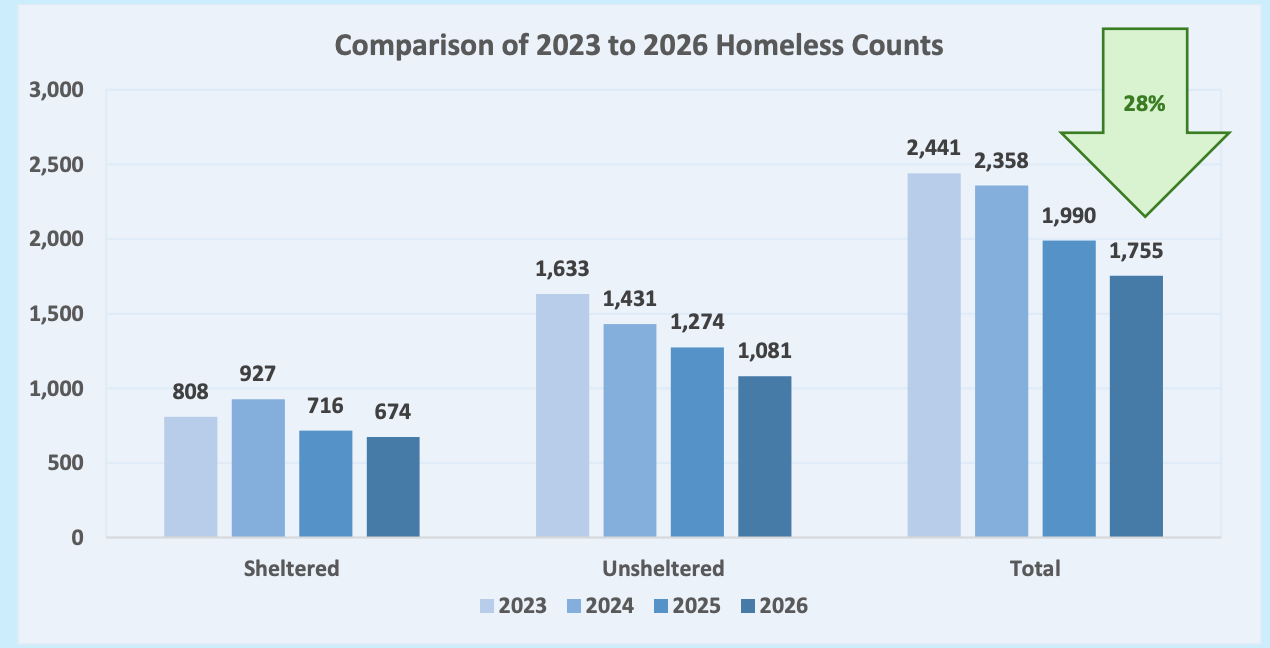
In Ojai, unfortunately, homelessness has increased since 2025.
Ojai is one of two municipalities in Ventura County to register an increase in unsheltered homelessness since 2025.4 On Jan. 28th, my fellow volunteers and I counted 72 unhoused individuals in Ojai.5 In 2025, that number was 60.
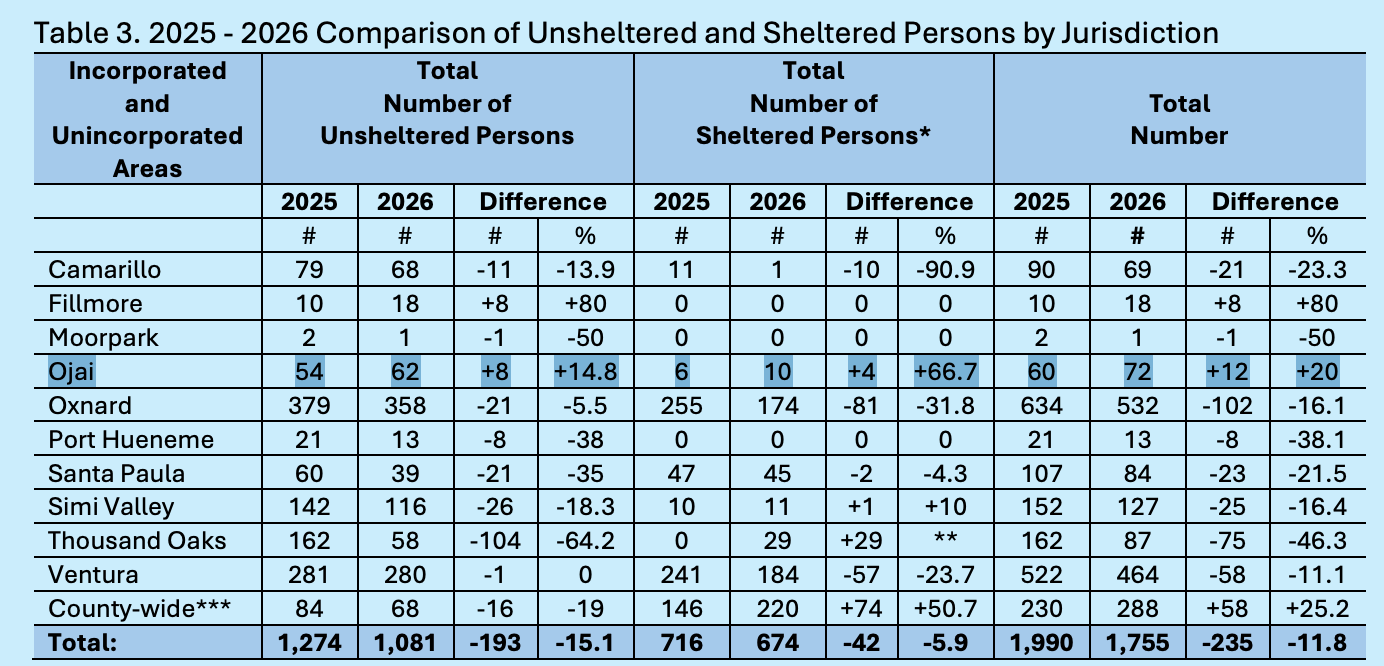
One takeaway: do not mistake the dwindling population of Ojai Tent Town for a decrease in local homelessness.
I asked HELP of Ojai Executive Director Jayn Walter for a comment on the increase:
“Ojai saw a 20% increase in homelessness, from 60 to 72 people, while the county as a whole decreased by nearly 12%. The difference comes down to infrastructure,” Walter said. “The communities that saw decreases have year-round shelters, transitional housing, and permanent supportive housing; when someone in those communities becomes homeless, there are stronger systems in place to respond.”
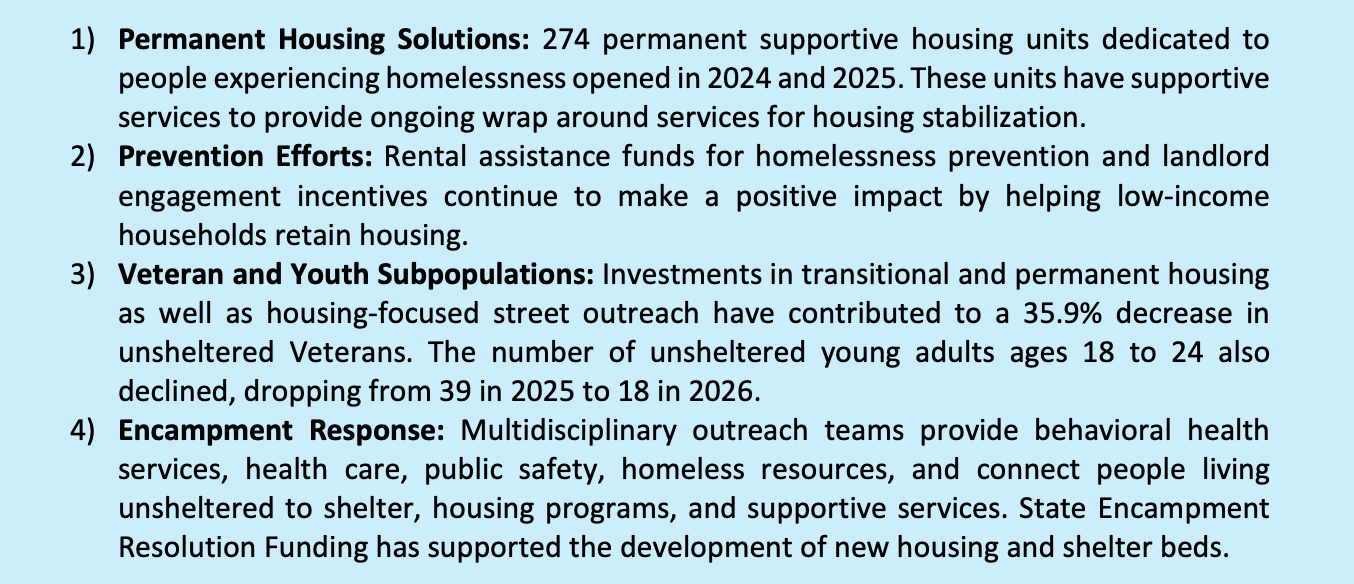
The Ventura County Continuum of Care (the local coordinating agency for homelessness services) made a similar observation in its executive summary for the 2026 Point-in-Time Count. According to the COC, one of the key factors in reducing homelessness countywide is an increase in permanent supportive housing. Here are the agency’s four primary takeaways:
At present, Ojai’s ERF-funded permanent supportive housing project is anticipated to be completed in July of 2027. That means (at least) two more summers at Ojai Tent Town. In Miller’s words, “Winter is miserable. But summer is deadly.”
I’m going to leave it there, folks. I’ll post meeting updates on Substack notes and Instagram.
If you don’t use social media — I salute you.
cue maniacal laughter.
Send an email to andra.belknap@gmail.com for a free trial subscription!
I’m not sure why they’re referring to the project as 31 units. That’s an open question.
Fillmore joins us in this unfortunate distinction.
Another one of my outstanding questions: it’s unclear how COC is defining “Ojai” in this report. TBD.