Groundbreaking! (Now What)?
Including: a civil grand jury report, checking in with future residents, a states v. feds legal battle, and more updates on Ojai’s permanent supportive housing project for the homeless.

Greetings readers!
Nearly three years ago, I began wandering around the Ojai City Hall campus. I was fascinated (and alarmed) by the site’s growing homeless encampment, and started interviewing folks living there.


I met fellow Ojai Unified School District graduates living in tents and makeshift shelters. I met immigrants, too: folks from other states and Spanish speakers from Central America. Some came to Ojai following Krishnamurti. Others raised families here. Others just wander. Some struggle with addiction or mental illness; many have disabilities. Some are elderly. Some work locally. Some aren’t interested in talking to a journalist. It’s a constellation of diverse stories, and it’s always changing — like any community.
At present, 22 people live at Ojai Tent Town, a sanctioned tent camp that sits a quarter mile from Ojai Avenue’s Arcade Plaza.1
Fixate with me for one moment, please: Ojai is an internationally known tourist town boasting small-town charm, luxury experiences, and spiritual wellness. It’s also home to an encampment populated by many longtime locals, just one quarter mile from the community’s most Instagram-able sights.
It’s a picture of California’s housing crisis coupled with American income inequality. I can’t look away.
All of my past reporting on Ojai’s homeless community — and the effort to house them — is available here. This project is entirely reader-supported. Paid subscriptions and donations support the work, as does sharing. Free trial and discounted subscriptions are available: email andra.belknap@gmail.com.
Groundbreaking! (Now what?)
On June 30, 2026, the City of Ojai and Dignity Moves broke ground on a $12.7 million state-funded 30-unit permanent supportive housing project intended to house the chronically homeless, many of whom currently make their home at Ojai Tent Town, located at Ojai City Hall.
As of August 11th, there’s no visible progress at the site.
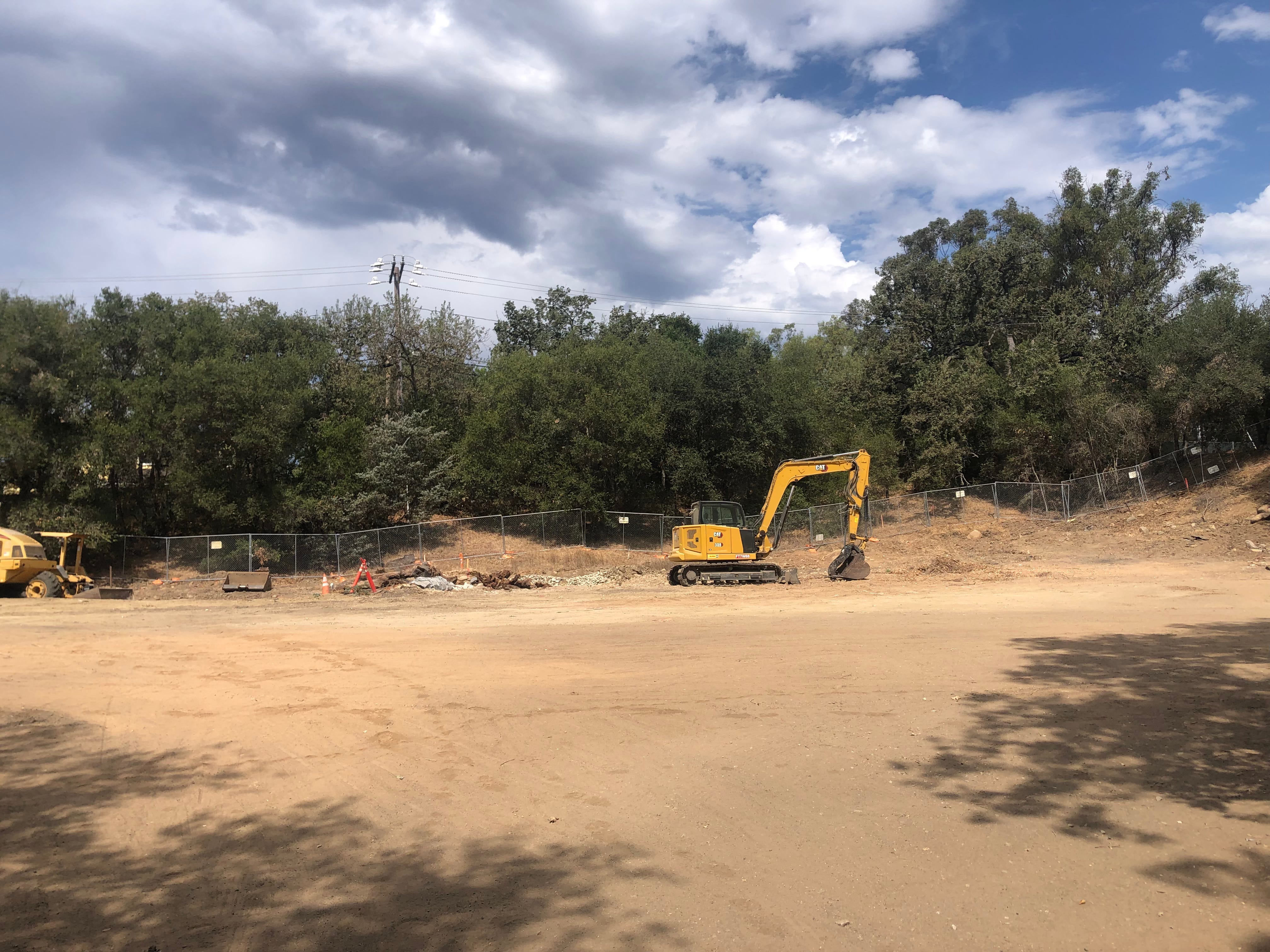
But that doesn’t indicate inaction, Dignity Moves’ Vice President of Construction and Project Management Jeff Spahr told me during a late July interview.
“Our big desire at this point is to get to what we call ‘coming out of the ground,’” Spahr said. “The civil work and all the below-grade [work]... it doesn’t appear to be making progress, but it’s meaningful and important.” He explained, “The primary work that needs to take place needs to do so under the supervision of a representative from the tribal community, the Chumash Indian Nation. And so we’re in the final stages of getting that contract set up… And then there are a few biological surveys being performed as we speak...”
The project is officially set for a July 2027 opening. I asked if the project is on track to hit that deadline — Spahr was careful not to answer.
“We would be happier if we were further along… It is currently what we are all tracking to, but there’s a lot of allowances set aside between now and then that are still kind of open in question marks…”
So — TBD.
How did we get here? I’m not going to force everyone to read three years of background — though I do encourage it :)
Let’s travel back to January 23, 2024.
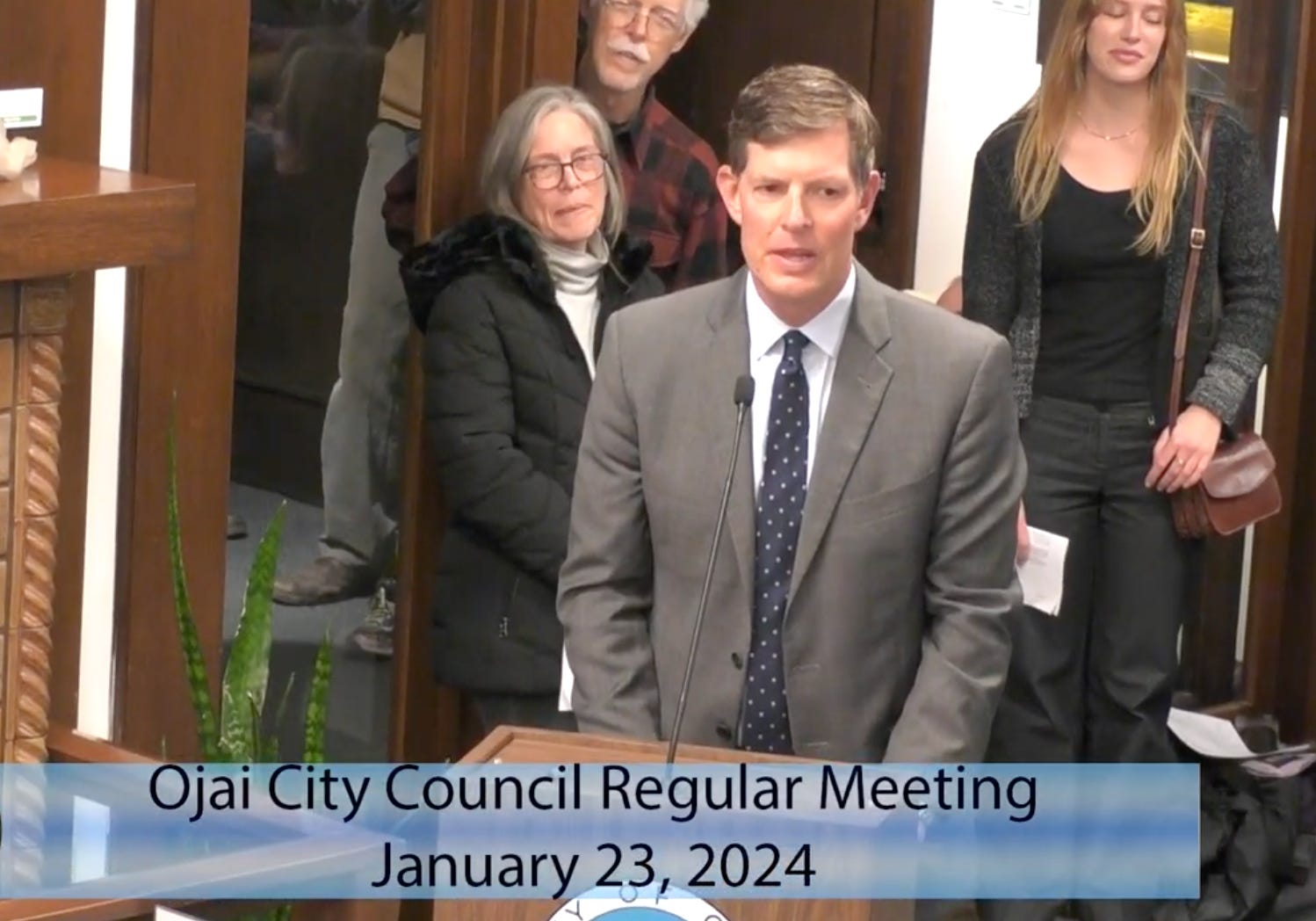
In response to the growing crisis on the City Hall campus — think unsanitary conditions, open fires, and vulnerable people — the Ojai City Council voted 3-2 to submit a grant application to the state’s Encampment Resolution Fund (ERF) to house the chronically homeless. The yes votes were cast by Councilwomen Rachel Lang, Leslie Rule, and Suza Francina. The noes came from former Ojai Mayor Betsy Stix and Councilman Andy Whitman.
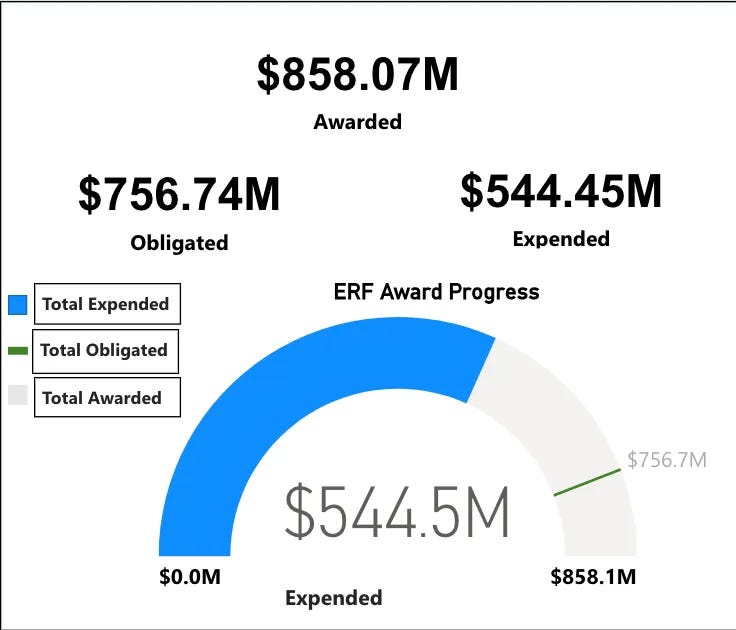
California’s ERF program began in 2021 as a $50 million competitive grant program to help local governments clean up encampments and get residents on a path to permanent housing. A product of the time when municipalities like Ojai were legally powerless to enforce anti-camping ordinances on public land, the program funds “Housing First” approaches to homelessness — a strategy the state of California codified in 2016.
Housing First is defined as an “evidence-based model that uses housing as a tool, rather than a reward, for recovery and that centers on providing or connecting homeless people to permanent housing as quickly as possible. Housing First providers offer services as needed and requested on a voluntary basis and that do not make housing contingent on participation in services.”
As of March 2026, the ERF program has expended nearly $900 million for more than 100 projects across California, including in many of Ojai’s Ventura County neighbors.
Ojai’s ERF grant application, crafted with support from the Ventura County Continuum of Care, proposed a partnership with developer Dignity Moves to construct 20 units of permanent supportive housing on the City Hall campus. The application refers to “modular units” with supportive services for residents and proposed housing the remaining campers in hotel rooms: a nearly $600,000 line item.
At the time of the vote, there was a general acknowledgment that a 20-unit housing project *shouldn’t* actually be sited at City Hall (in the footprint of what is presently Ojai Tent Town). But — the Council and assembled public couldn’t come up with a better location prior to the application deadline. I’ll note that the proposed project budget was not complete in time for the Council vote authorizing the application submission — though it did make it into the package submitted to the state of California on February 1st.
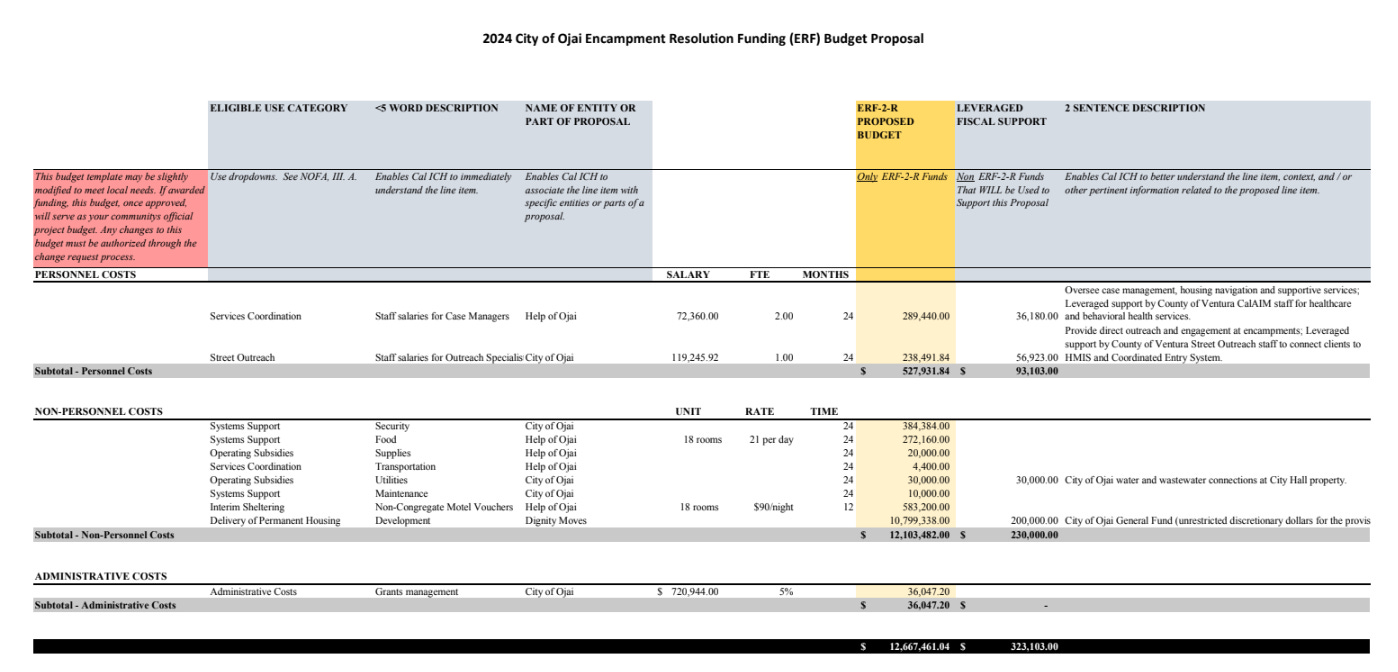
And folks, despite a semi-nebulous project concept and a split City Council, the City of Ojai won $12,667,461.04 in state grant funds on April 18, 2024: the full amount requested in the application.
Over the next six months, the housing project changed locations twice and expanded, morphing into a custom 30-unit “mission-style” housing development at the City’s former public works yard.
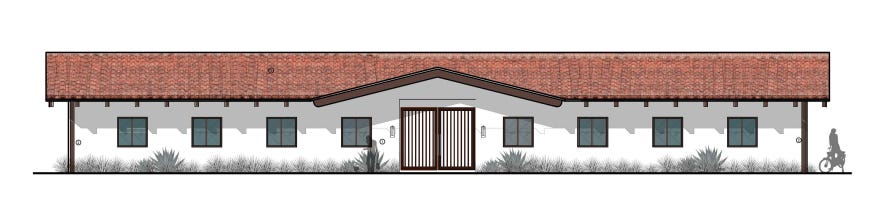
There has been plenty of disagreement and controversy along the way—regarding the project’s budget and future operating costs, soil toxicity at the housing site, and continued debate over the location. (Check out this series to learn about all the bumps along the road.)
Let’s zoom forward to March 25, 2025: nearly one year after the City received its $12.7 million ERF grant award. That’s when the Ojai City Council voted 3-2 to negotiate a development management agreement with Dignity Moves for design and construction of the 30-unit housing project. (Gilman, Lang, and Rule voted yes; Mang and Whitman voted no). Remember that vote, folks — it will come up again.

That $10 million development management agreement (a $9.5 million construction budget plus a $500,000 development fee for Dignity Moves) returned to the City Council for approval on May 27, 2025. The Council signed off with another 3-2 vote with a familiar split: Gilman, Lang and Rule remained the majority in favor of the development. The City of Ojai cut a $5.9 million check to Dignity Moves on June 4th. Dignity Moves began soliciting feasibility studies and project bids from contractors that July.
You may be wondering: $10 million? What happens to the remaining grant funds? According to a state budget filing (and City Manager Harvey), $2 million in state grant funds are dedicated to future operations ($500,000 annually for four years).
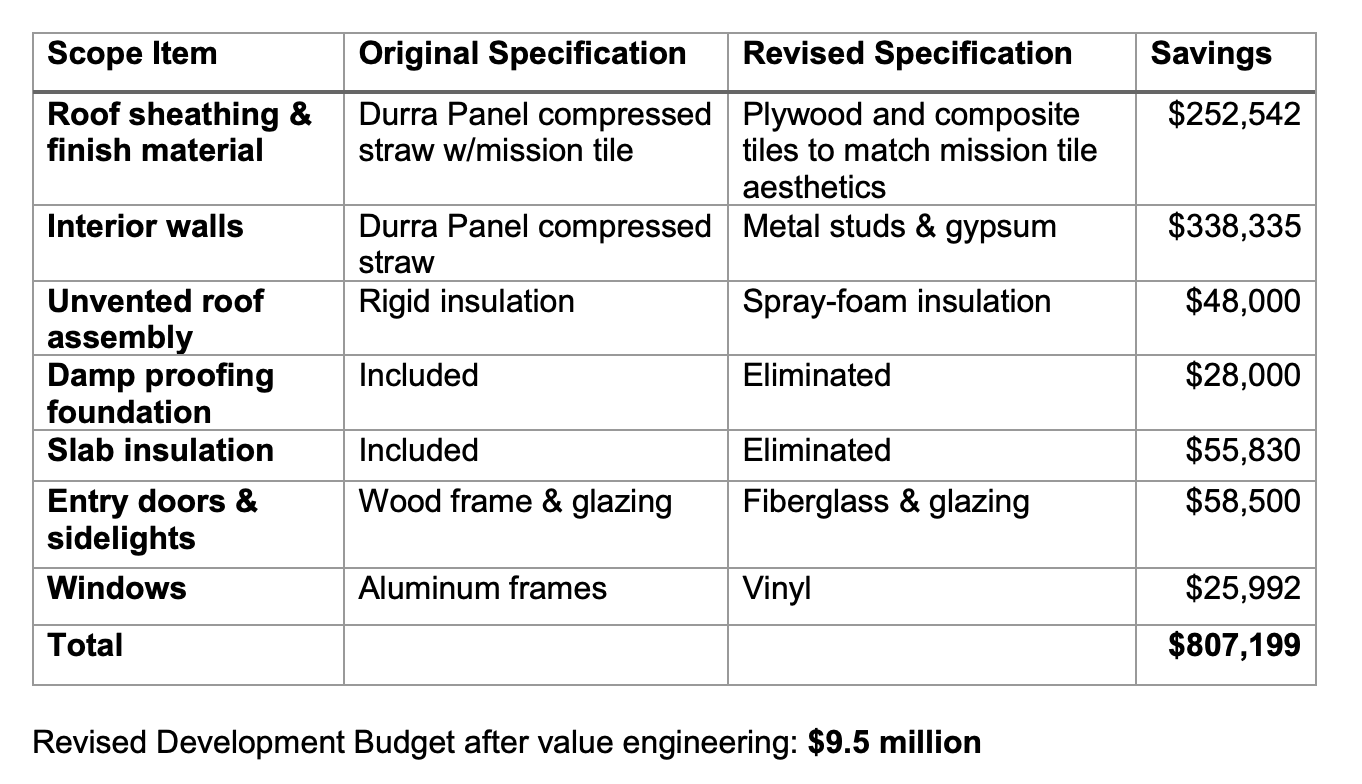
Dignity Moves reappeared before the Ojai City Council three months later, September 9th, with an update and some unfortunate news: their draft budget exceeded the $9.5 million construction budget by more than $800,000. As a result, some project elements were removed, and some materials were downgraded.
Councilwoman Rule attended the Council session via Zoom from across the pond. She had traveled to Cambridge to address the European Animal Rights Law Conference about the City of Ojai’s ordinance affirming local elephants’ rights to bodily liberty.



Nonessential details aside, Rule was displeased with some savings-motivated changes to the housing project, particularly the reduction in the use of natural building materials. She moved to reject the budget update from Dignity Moves, joined by Whitman and Mang. Gilman and Lang voted against Rule’s motion.
Still, the project moved forward. Three general contractor bids arrived before the Ojai City Council on April 14, 2026. Once again, there was unfortunate news on the budget side. Each bid came in at over $10 million, even with cost-saving measures.
“As we all know, the bidding process took place in a challenging time in the construction market. Things are expensive. The budget was tight,” project architect Dylan Johnson acknowledged.
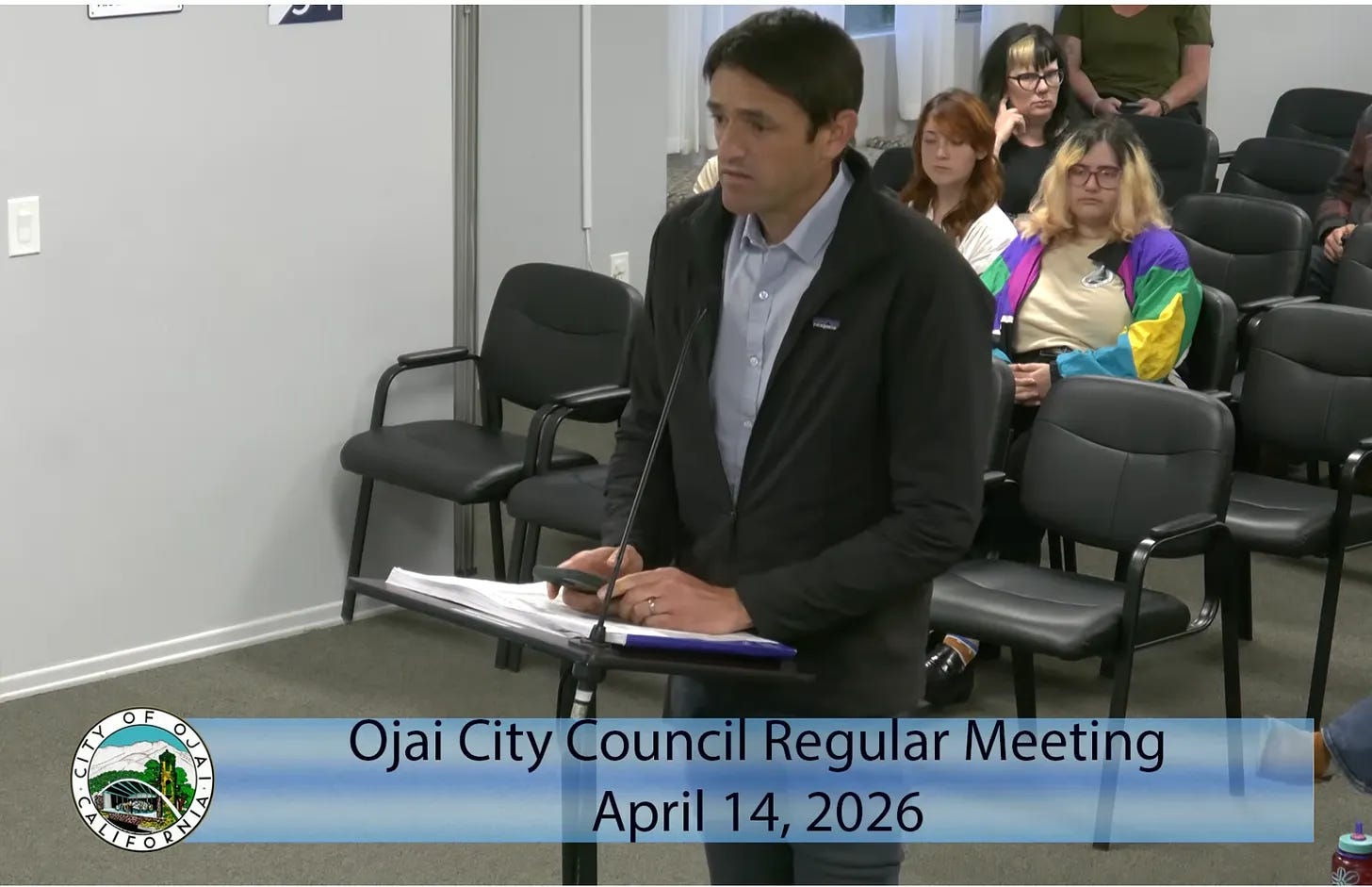
In order to move forward, the City Council was obligated to approve a project budget from the lowest bidder, San Luis Obispo-based Specialty Construction. The budget — or bid — included additional cuts to the project, removing landscaping, storage space, common-area appliances, decorative elements, more natural building materials, and acoustic panels.
Rule, along with the assembled public, was well aware that the project could not move forward without her support. And she was displeased.
“[This] has been horrible,” Rule said of the process. “It has been horrible since September 9th when Dignity Moves gave us a budget that was not real.” She ultimately cast her vote in favor of approving the lowest contractor bid and construction budget.
“I don’t appreciate a gun to my head by anybody,” Rule concluded. “So I’m voting yes with a gun to my head because I can’t possibly vote no.”
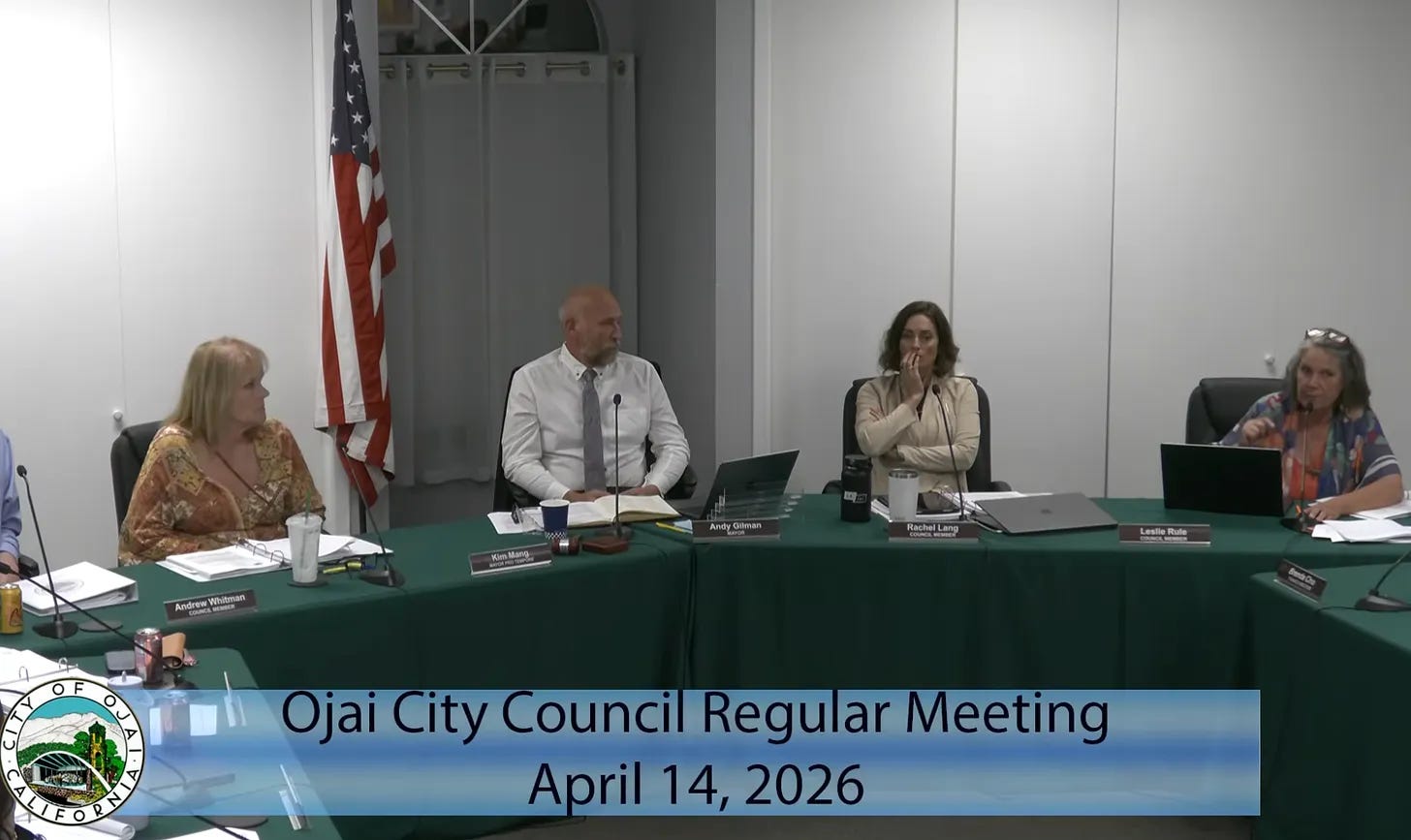
That dramatic April vote cleared the way for the June 30th groundbreaking ceremony on Montgomery Street.
Five days prior to the groundbreaking ceremony, however, the Ventura County Civil Grand Jury announced it had investigated the process by which the City of Ojai awarded the $10 million development contract to Dignity Moves, and determined that the City violated the law. The Civil Grand Jury — a volunteer panel of county residents who investigate alleged misconduct in local government — specifically found that Ojai selected Dignity Moves for inclusion in its ERF grant application, and later awarded the multi-million-dollar development management agreement “without conducting a fair and competitive selection process based on qualifications and competency as required by law.”
Oops.
The law they’re referring to is California Government Code section 4529.12:
“All architectural and engineering services shall be procured pursuant to a fair, competitive selection process…”
The investigation followed a citizen complaint regarding the Council’s March 2025 vote (the one we pledged to remember) authorizing Harvey to negotiate the multi-million-dollar contract with Dignity Moves. Ojai Finance and Budget Committee Member Clay Creasey, a consistent critic of the project, acknowledged to the Council in July that he “had a role to play in getting this matter adjudicated by the grand jury.”
The grand jury further “discovered that the possibility of running out of time and potentially missing opportunities or important deadlines came up as a consistent theme in Ojai’s decisions to circumvent the required fair and competitive selection process. Whether it was the looming deadline to submit the grant application, or the imminent deadline to spend 50% of the grant or risk losing the funding despite not having a contract in place, Ojai certainly faced pressure to keep the project funded and moving forward.”
Honestly — sounds like an accurate assessment to this observer. The California Department of Housing and Community Development, which administers the ERF program, had no comment.
One hour after the grand jury report became public, I received a joint press statement from Councilmembers Mang and Whitman, announcing that neither would attend the June 30th groundbreaking ceremony. In a statement, the duo said (in part):
“...as stewards of taxpayer resources, we have a responsibility to ensure that every project we fund is transparent, financially sound, and sustainable in the long term. This city council too often throws money at problems without digging deeper into addressing the cause of the problem, without developing comprehensive planning and without developing economically viable long-term solutions. Before committing our full public support, we believe it is essential to have a clear, detailed budget and a sustainable funding plan.”
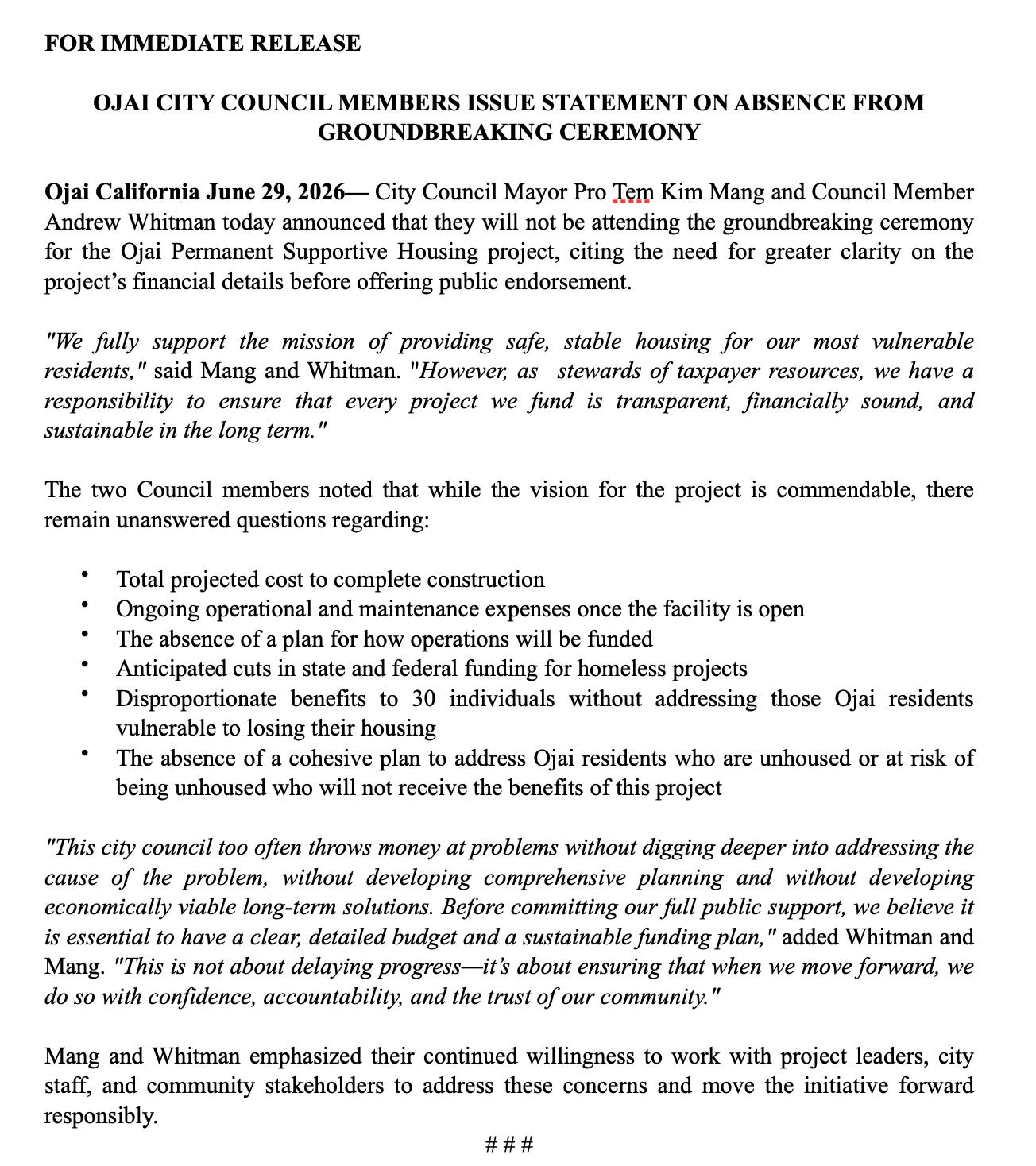
Mang and Whitman stated they have “unanswered questions” regarding (the following bullet points are quoted from the press release):
Total projected cost to complete construction
Ongoing operational and maintenance expenses once the facility is open
The absence of a plan for how operations will be funded
Anticipated cuts in state and federal funding for homeless projects
Disproportionate benefits to 30 individuals without addressing those Ojai residents vulnerable to losing their housing
The absence of a cohesive plan to address Ojai residents who are unhoused or at risk of being unhoused who will not receive the benefits of this project
There are important considerations here, particularly regarding future funding; there are also embedded opinions which readers can weigh.
But before we get into the future funding question — which involves a states vs. feds legal battle — let me give you a window into the groundbreaking ceremony, which proceeded despite Mang and Whitman’s absence.
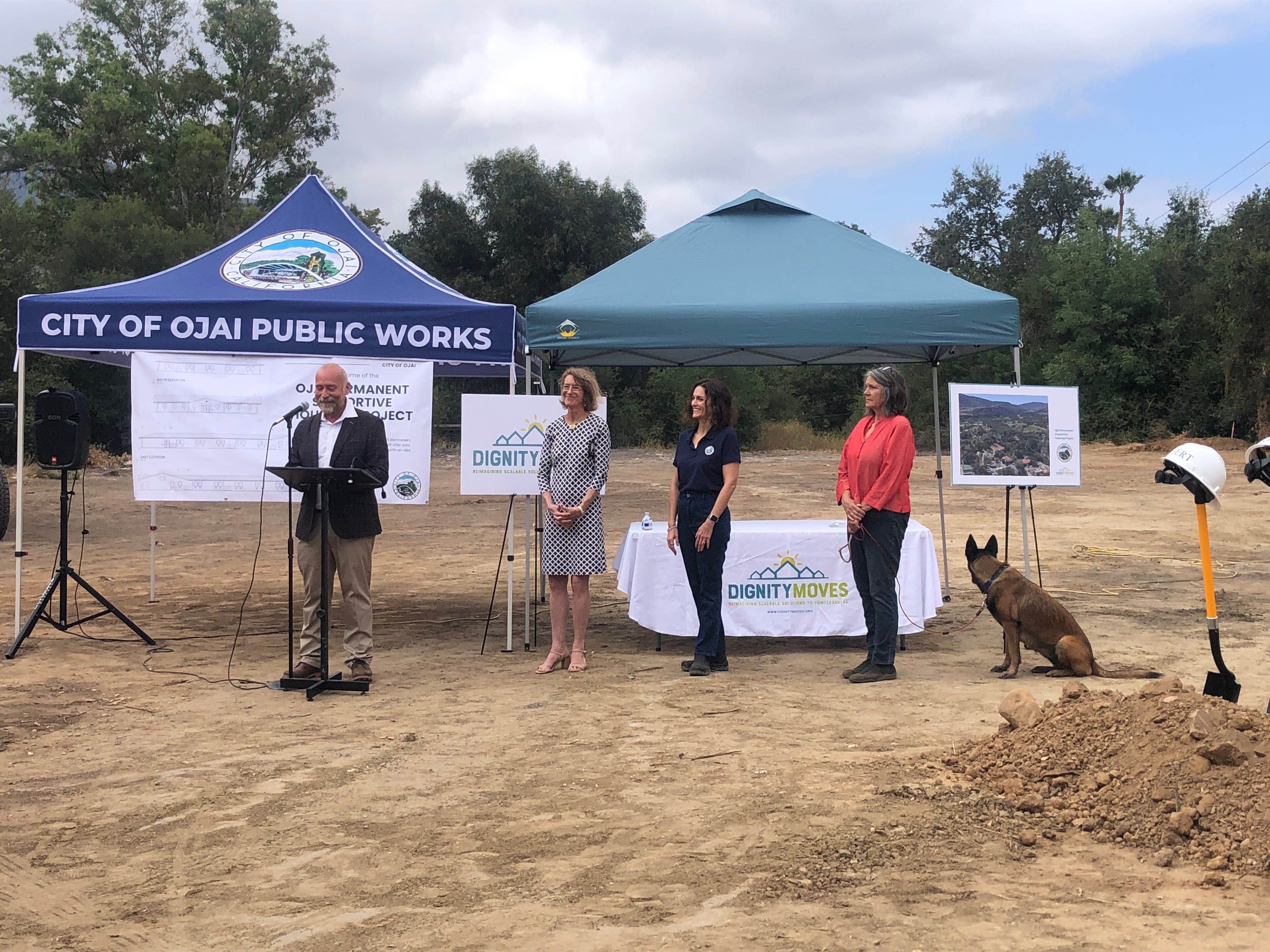
Lang was visibly emotional during the ceremony, “I don’t think there’s anything more important that I’ve done,” she shared.
Rule was her usual quotable self. She concluded her remarks with, “I can’t wait to get the ground broken. Like I say to my dog, ‘We’re all go!’” (She was accompanied by her canine companion Willow.)
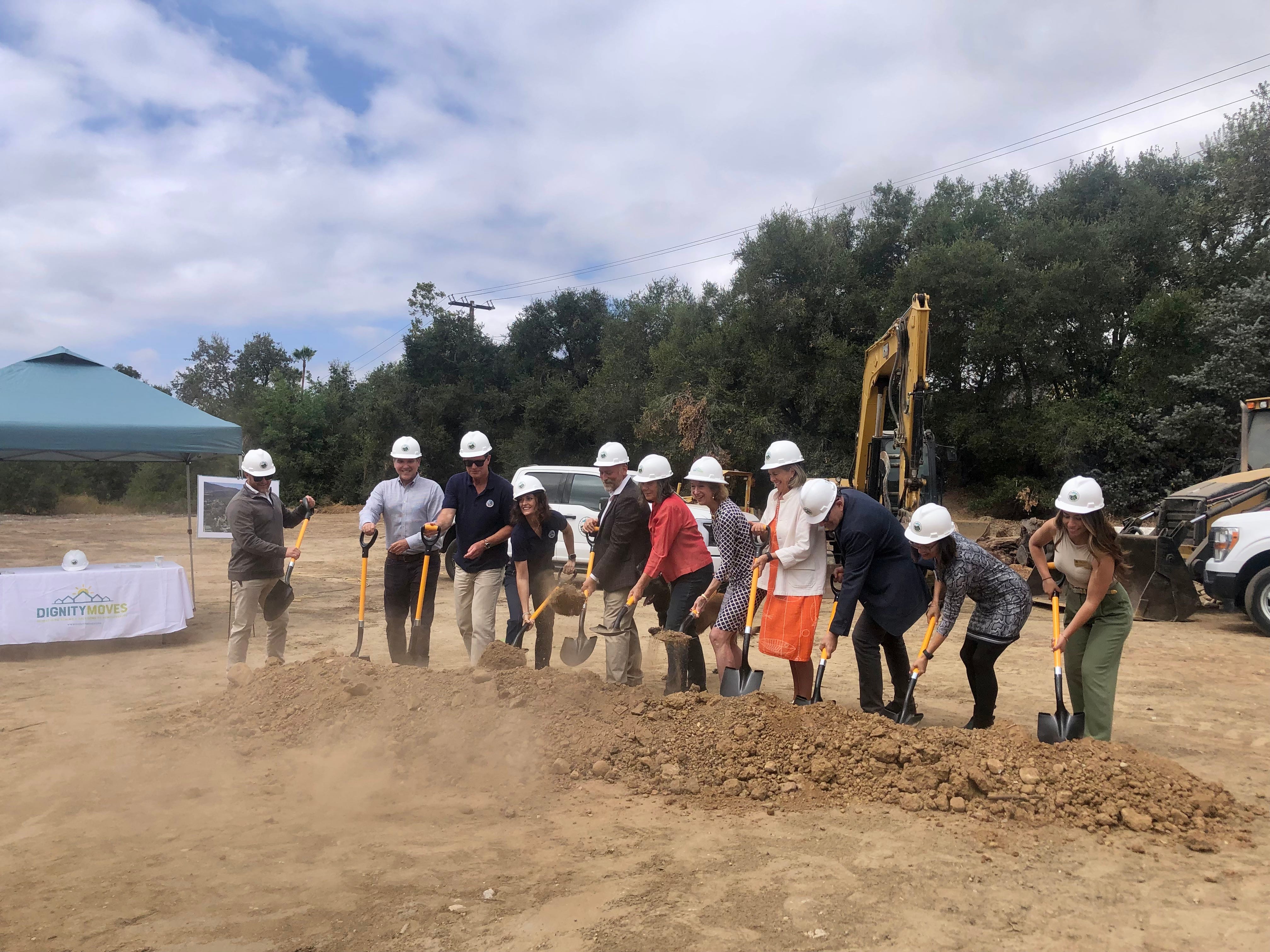
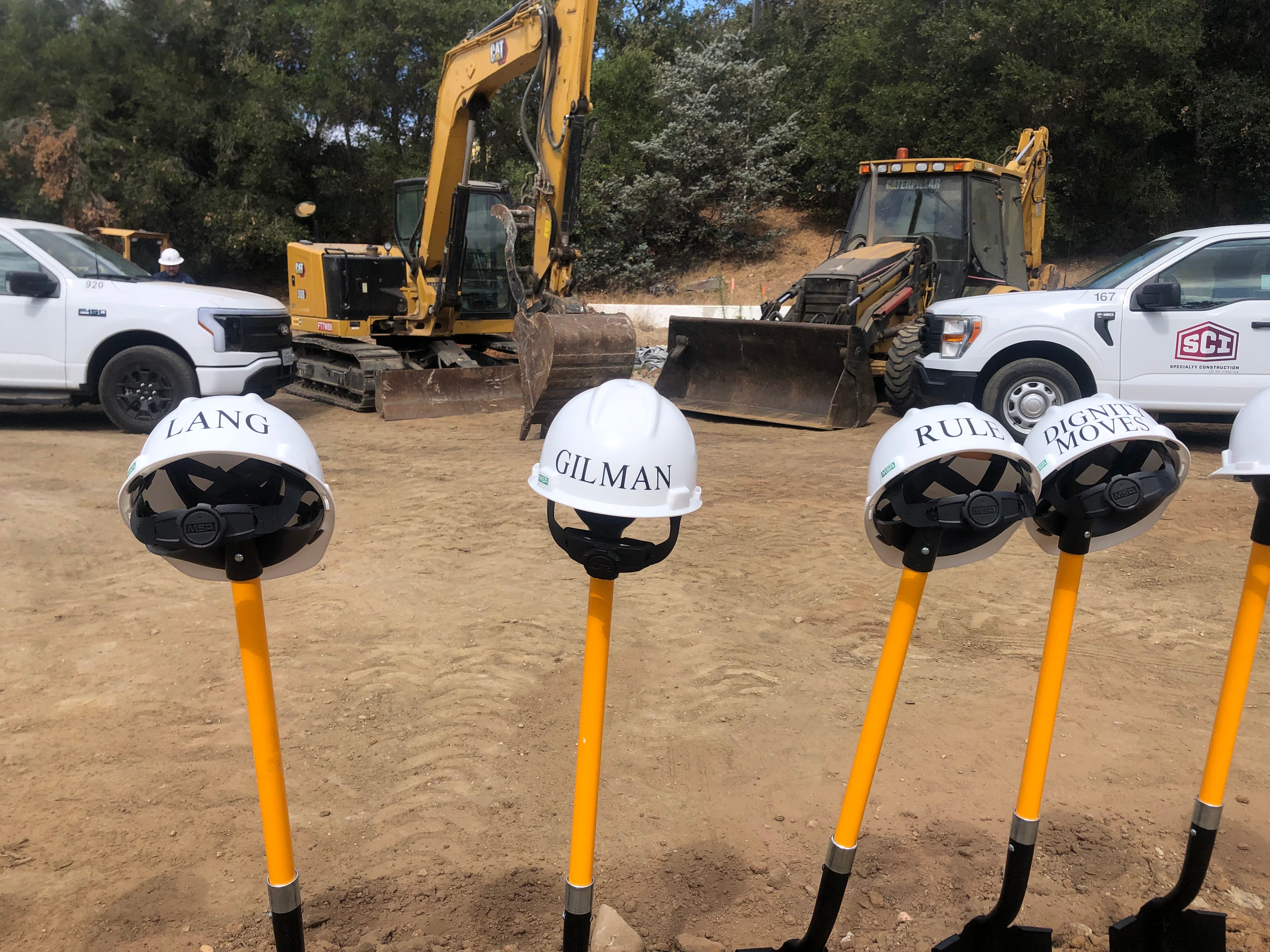
After a round of applause, elected officials, public employees, and Dignity Moves CEO and founder Elizabeth Funk made their way to what I’ll describe as a photo-friendly pile of dirt, with nine shovels thrust atop, each with a personalized construction helmet balanced on its handle.
In unison, the nine filled their shovels with dirt and playfully (artfully?) threw it into the air. With that, the ground was considered “broken,” folks embraced, and I scurried off to conduct interviews.
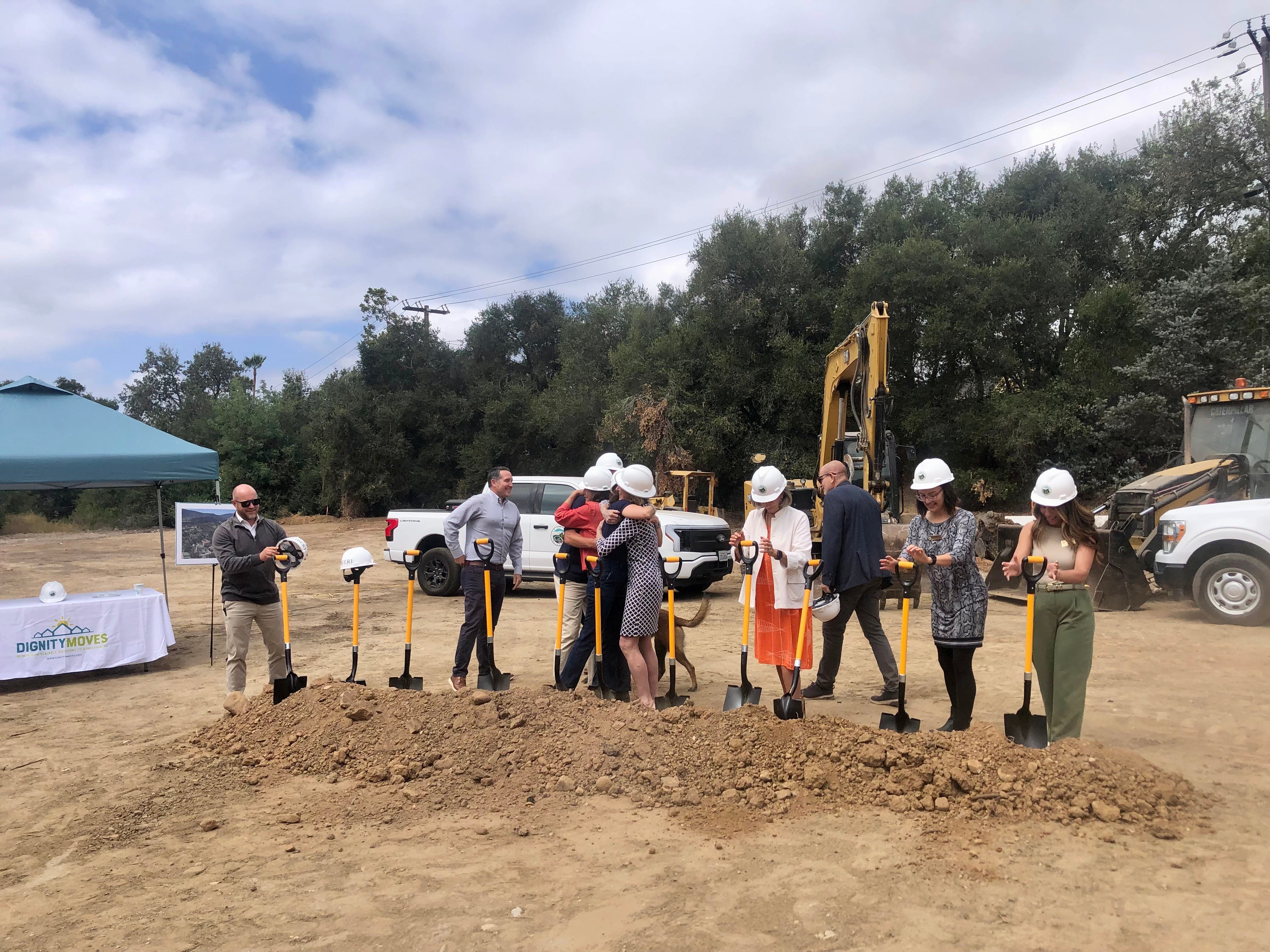
I first caught Funk for a comment on the grand jury report.
“In terms of competitive bids, we find that when we apply to state grants like [Project] Homekey or Encampment Resolution, it’s the state that’s reviewing them and selecting fairness and whether it’s competitive because it’s the state’s money,” Funk said, acknowledging she had not yet read the report. “We have done a lot with the state, so the state knows us well and knows that we deliver on time and on budget. And so the state selected this project.”
I also asked her about the length of the development process, given that groundbreaking took place more than two years after Ojai received news of its grant award.
“Well, there’s been a lot of neighborhood input and the city has taken that very seriously, honestly, more than most cities do. I mean, 20 community meetings — I’ve never heard of anything like that,” Funk said. “Most of our projects have one community meeting. And it’s not asking for permission — it’s showing them site plans.”
Future Residents
A dozen or so Ojai Tent Town residents made their way to Montgomery St. for the groundbreaking ceremony. Let’s check in on a few folks who hope to make their home in the development, shall we?
Danielle Alstot has lived on the City Hall campus with her partner Josh for more than three years.
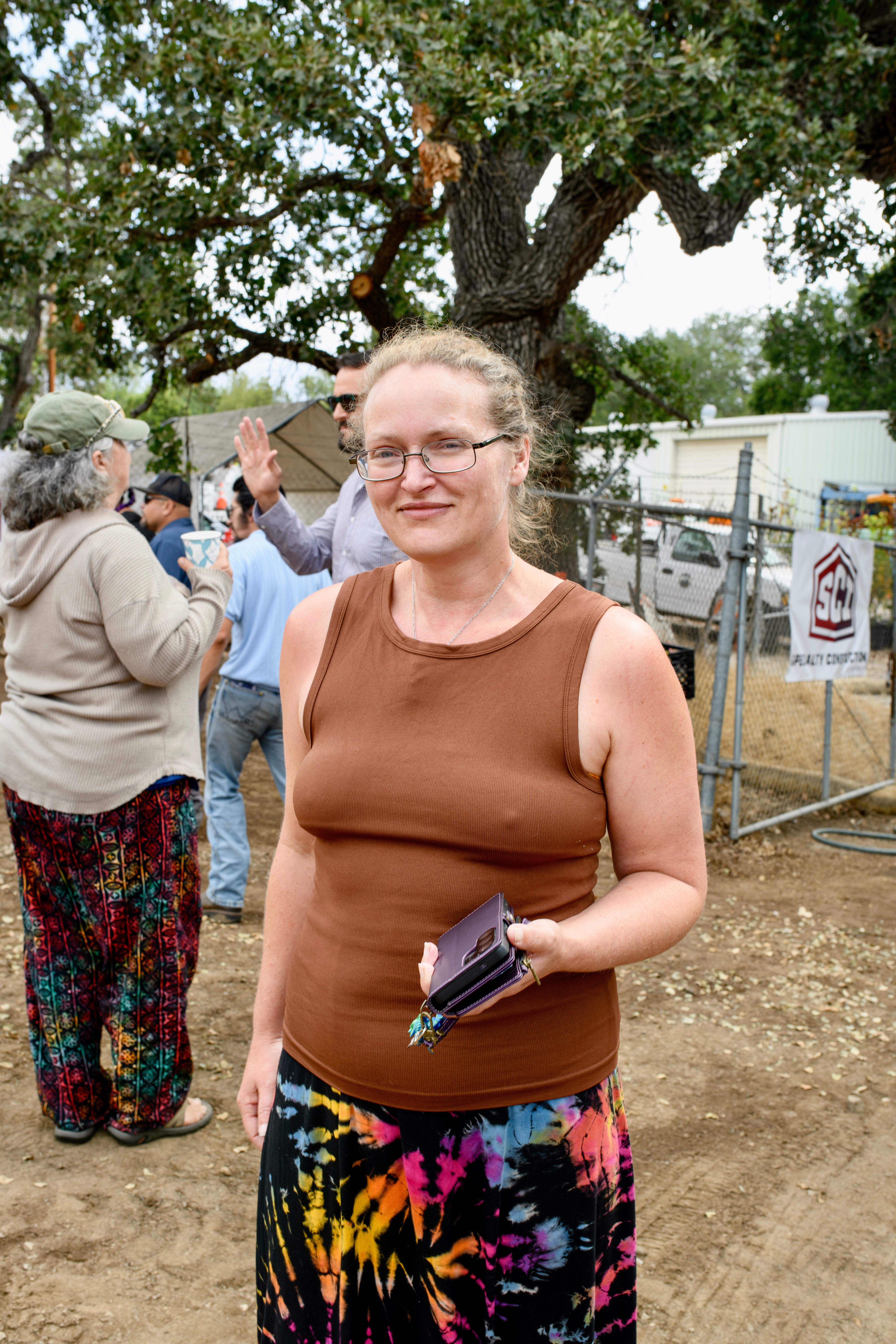
We first met Alstot in 2024.
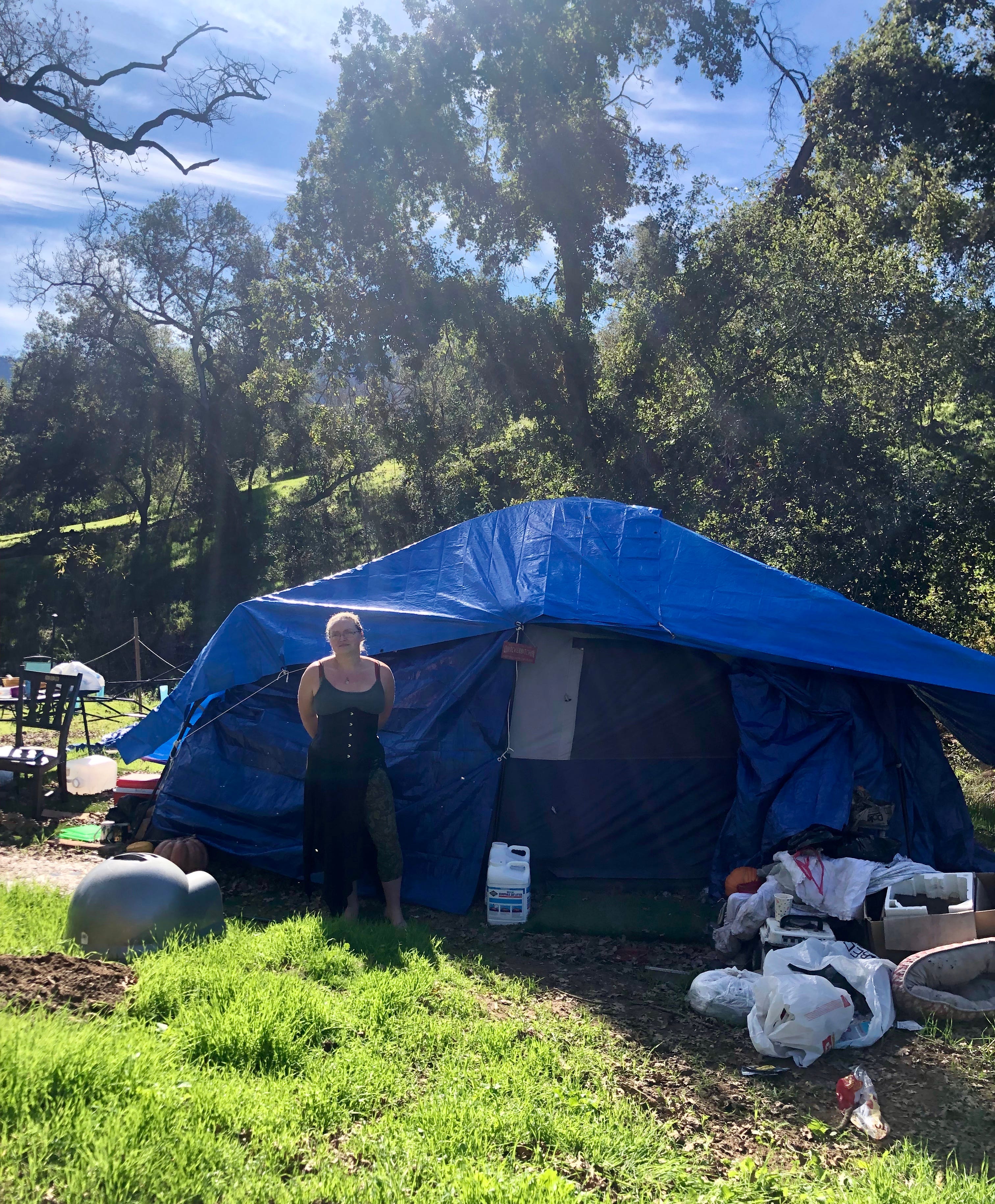
I asked her if she’s feeling hopeful about moving into the development. “I hope so,” Alstot said. “But at the same time, my boyfriend is talking about going back to trucking so he can make enough money. Our only goal is [that] I need to be behind a door that locks before he goes out for months.”
She continued, “If I had a stable locking door and could sleep through the night without having to worry about all the sounds outside and who’s doing what to what we own, I could even go back to work. But I’m not sleeping.”
Alstot has consistently raised concerns about drug use and security at Ojai Tent Town.
“We have one security guard. There [are] still people jumping fences [and] being invited in,” she said. “There’s people… who come back onto the property who are drug addicts and dealers. All the security would be great if we actually gave them enough authority to do something about it… We hired security to have conversations. That’s it.”
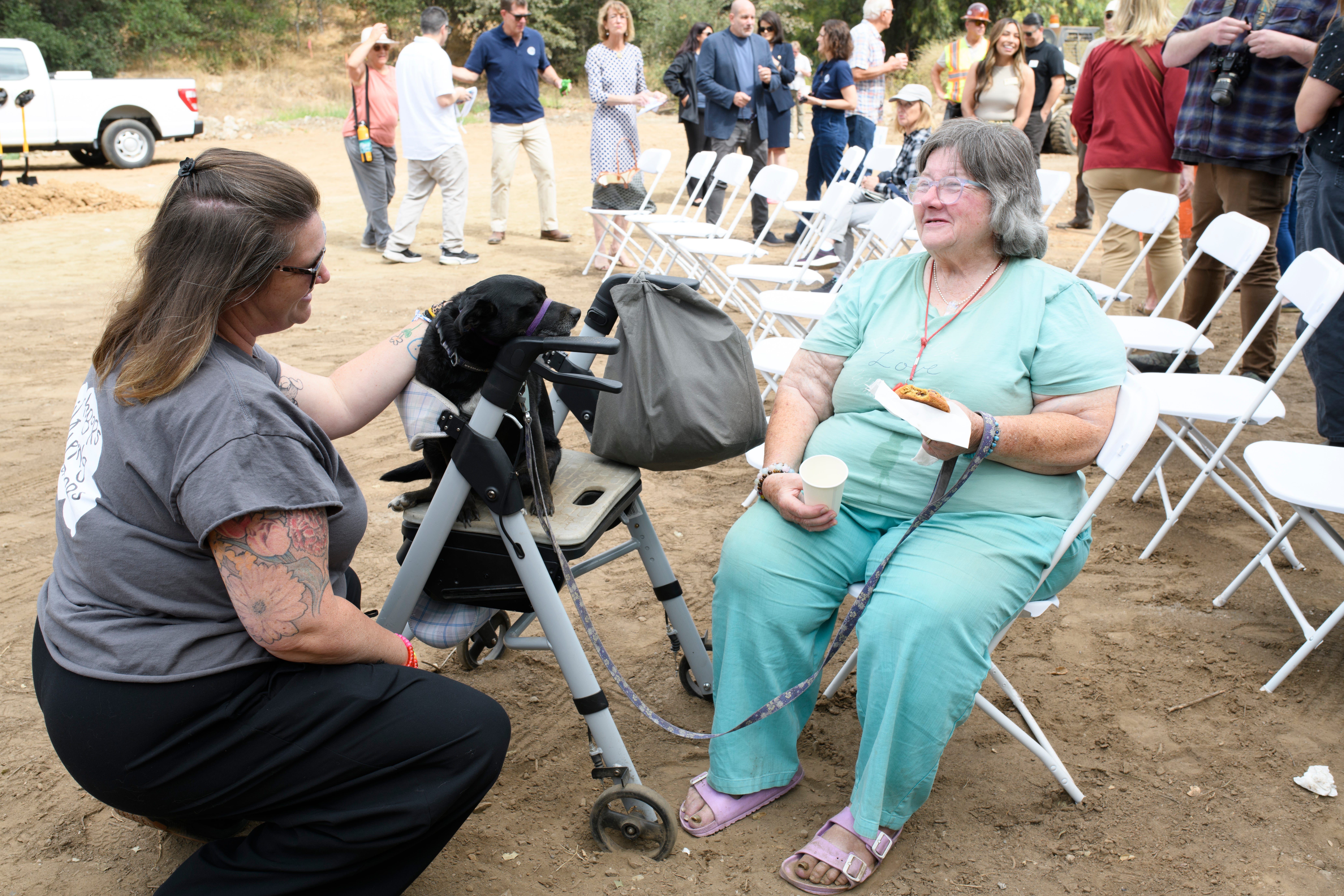
Jamie Nelson, a well-known resident of Tent Town, also told me that she’d had trouble sleeping, too — she’d heard what sounded like a small animal in her tent the night before, she said. “It scared me some because it could be a rat and I’m definitely afraid of rats… And I heard [another resident] got bit a couple of times.”
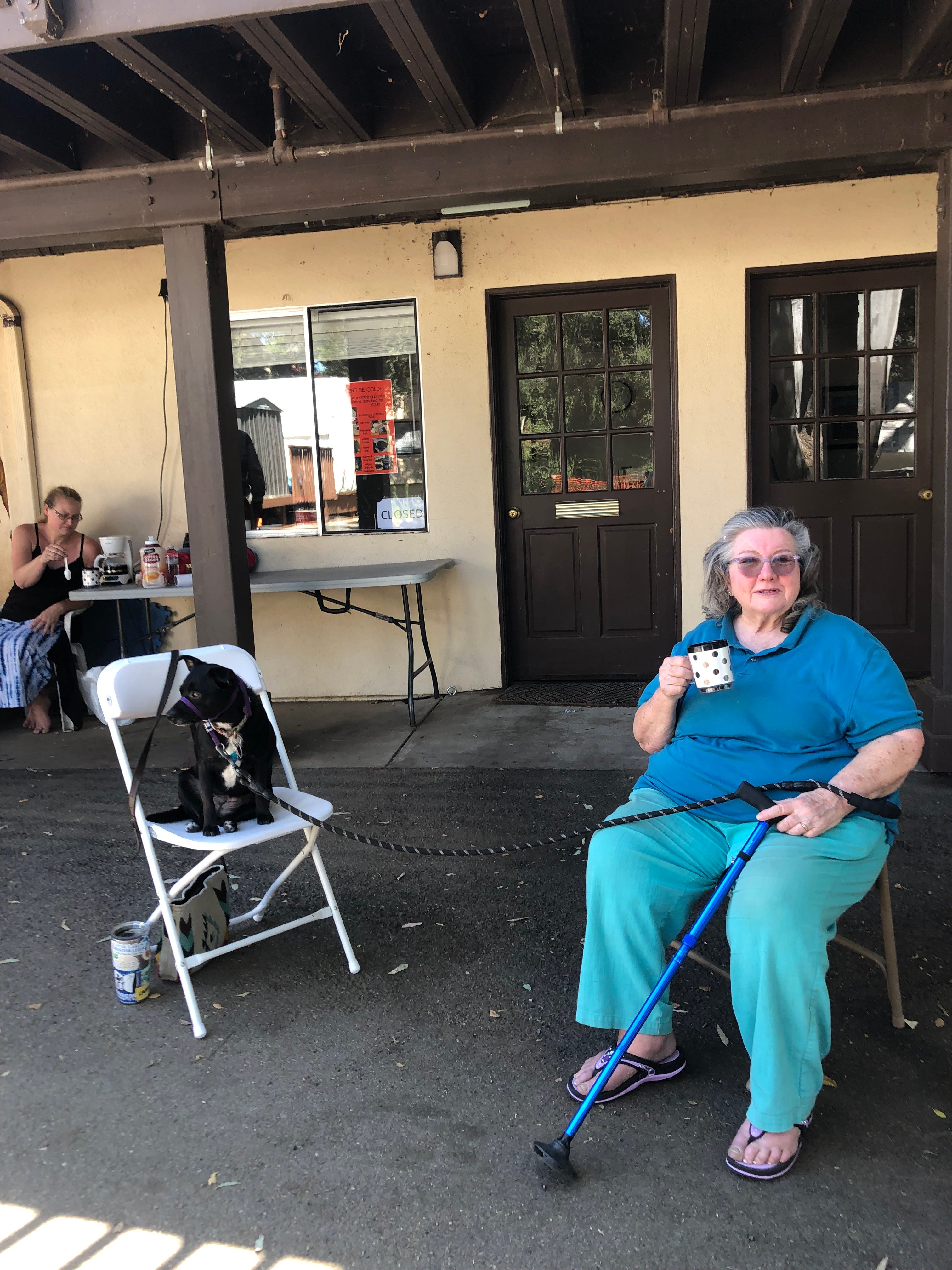
Though she was feeling sleepy, Nelson, 76, said the event was “very heartwarming” and the property felt like home. “I like the way the trees are all the way around, and my granddaughter’s with the Green Coalition, and she’s helping with the planting,” she added.
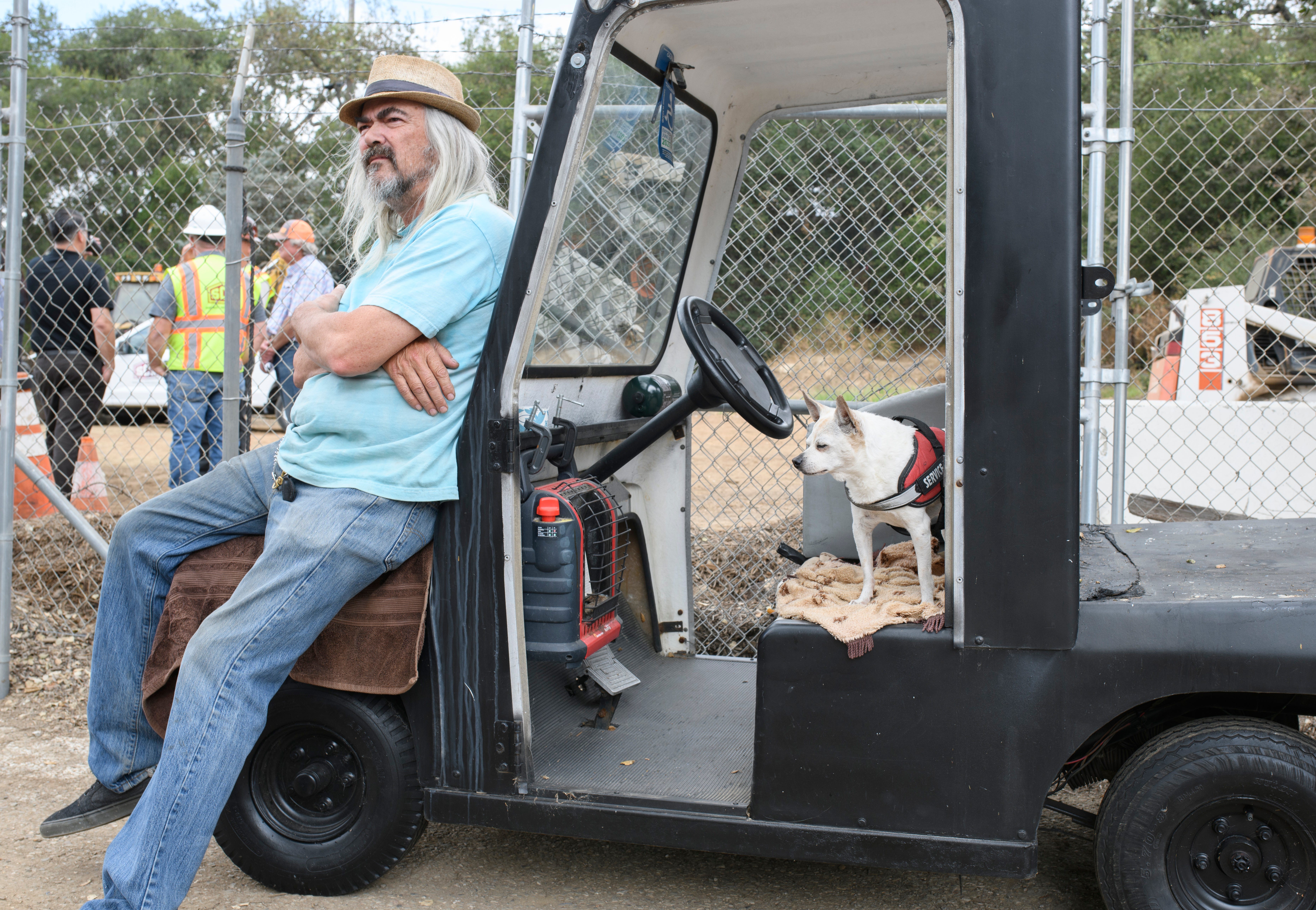
William Holden claimed responsibility for the camp at City Hall back in 2023. Today, he’s nearing the top of the waiting list for another affordable housing development in the City of Ojai. “Just this morning I resolved myself to have a good intention regardless of the [affordable housing] outcome because I’m here. I have this. This is what I’ve helped create,” he said of the project.
The process of navigating the system is challenging, Holden said, observing “institutional violence doesn’t look like a gun or a knife. It looks like paperwork.”
VARIOUS POTS OF MONEY
Ok — let’s return to Mang and Whitman’s concerns about sustaining the housing project into the future. Who’s ready for a quick dive into national politics?!
Remember Housing First? Members of the Trump Administration are not fans; they’ve proposed cuts to federal funding for permanent supportive housing in favor of transitional housing and mandatory supportive services.
Wait — what are supportive services? Everything from mental health services to helping folks access food stamps. Supportive services consistently invoked by the Trump Administration involve mental health and addiction treatment.
Recall that Housing First uses housing as a tool — this model uses it more like a reward for participating in supportive services.
Here’s U.S. Department of Housing and Urban Development (HUD) Secretary Scott Turner on Housing First:
“The ‘housing first’ experiment failed Americans by warehousing the vulnerable without results. This ideology promised to end homelessness. Instead, billions of taxpayer dollars were spent while homelessness increased to record levels. Housing alone will not solve a crisis driven by addiction and mental illness. Under President Trump’s leadership, HUD is making necessary reforms to put recovery first.”
It’s a massive ideological shift, one that flows directly from the Oval Office. In a 2025 Executive Order, President Trump called for “ending support for ‘housing first’ policies that deprioritize accountability and fail to promote treatment, recovery, and self-sufficiency.”

I asked HELP of Ojai Case Manager Whitney Nunes for her thoughts on the policy shift — Nunes works with the population of Ojai Tent Town daily.
“Hearing that they’re not wanting to fund the permanent supportive housing, but more transitional housing makes me really nervous because if we don’t have permanent, supportive, affordable housing for people, where are they transitioning to?”
In their effort to end Housing First, the Trump Administration has attempted to limit federal funding for permanent supportive housing projects, sparking a state vs. feds legal battle.
On July 7th, 2026, twenty-two U.S. states (including California) sued Trump and co. for capping permanent supportive housing funds available through Continuum of Care (CoC) organizations nationwide.2 (Recall the Ventura County CoC’s role in crafting Ojai’s ERF grant application.)
If Trump’s funding cap was allowed to proceed, the plaintiff states argued, “a large number of CoC-funded permanent housing projects will lose their funding or see it reduced, resulting in tens of thousands of formerly homeless individuals and families being evicted back to the streets, with states and local governments left to pick up the pieces.”
A Rhode Island Judge threw out the feds’ proposed funding cap on August 7th — though nothing bars the same battle from happening over again in 2027.
American politics in action.

I spoke to County Homelessness Solutions Director Kimberlee Albers about the various pots of dollars available to housing projects like Ojai’s, including those CoC dollars the Trump Administration has attempted to cap. “...These funds are annual mostly, Albers explained, “[so] we have to get closer to project completion and really understand who’s going to be served there based on who’s at [Ojai] Tent Town by then to better figure out which [funding] sources fit.”
Permanent supportive housing funding, Albers said, is also available through state programs like HOME Investment Partnerships Program, Permanent Local Housing Allocation Program, the Behavioral Health Services Act, and the federal Community Development Block Grant program.
Got it?!
Let’s take a look into one more pot of money: Ojai’s $12.7 million in state ERF funding.
Recall that the City of Ojai cut a $5.9 million check to Dignity Moves on June 4, 2025. Approximately $840,000 of those dollars have been spent as of June 2026, according to monthly funding updates from Dignity Moves. The remaining dollars, according to Harvey, are held in interest-bearing accounts. “This is a requirement of the grant. You take interest earned from the grant, and you apply it towards the project.”
I will note that Dignity Moves’ most recent budget update incorrectly showed the total project budget as $16.5 million. The report has since been corrected as of August 4th, reflecting a budget of $9.5 million.
Oops.
Creasey, the Finance and Budget Committee member who acts as an unofficial project watchdog, commented in a letter to the City Council and City staff, “... someone needs to read Dignity Moves the Riot Act for submitting such an absurd document, and someone needs to seriously question what standards, if any, Mr. Harvey is applying to the draw packages that he is approving.”
My friends, that brings us approximately to the present. On August 11th, the Ojai City Council will discuss multiple dimensions of the project including: a proposed response to the Ventura County Civil Grand Jury report, outside donations to the project, soliciting a project operator (managing the project and supportive services day to day), and potentially soliciting a construction manager.3
Those final two items do not come with price tags, nor do they necessarily obligate the Council to award a contract. Council approval would initiate a “request for proposals” process to solicit responses (and budgets) from qualified organizations. Historically, Harvey has said he expects the project to cost the City of Ojai $500,000 to operate annually.
We shall see.
I’ll leave the final word today for Ojai Tent Town resident William Holden, on the morning of the June 30th groundbreaking ceremony.
“It’s been a long time coming. I’m hopeful that the typical California grind that slows every project to a near halt is somehow sidestepped in this wonderful little town of ours, and I wish the best for the program.”
Population number via HELP of Ojai.
Remember: Congress makes the laws which determine how our federal dollars are spent. The executive administers those federal dollars, in accordance with the law. The Trump Administration runs into this separation-of-powers problem regularly.
According to the staff report, “it is in the City’s best interest to retain an independent Owner’s Representative/Construction Management consultant to provide professional oversight and represent the City’s interests throughout construction.”
Great article Andra. Reflects a lot of reporting work!
A Herculean effort in providing a well written and comprehensive overview of this incredibly mismanaged project, Andra. I applaud your efforts and appreciate the time you have spent in keeping all informed.