Dispatch from Ojai City Council: Voting rights, dueling Democrats, and big feelings
A long-winded preview of the forthcoming elections, perhaps.

Greetings readers.
Today, let’s dive into the local political debate that led one elder Ojai woman — frustrated during a May 26th city council meeting when it became clear her side was in the minority — to stand up and declare:
“I’m a spirit. I’m so much bigger than this.”
“Period,” she added, in a wonderfully dramatic tone, before striding out of the meeting.1
Today, my friends, we’re jumping into the debate over at-large vs. district-based elections. This more-interesting-than-it-sounds discourse fits into a national conversation about our constitutional rights.
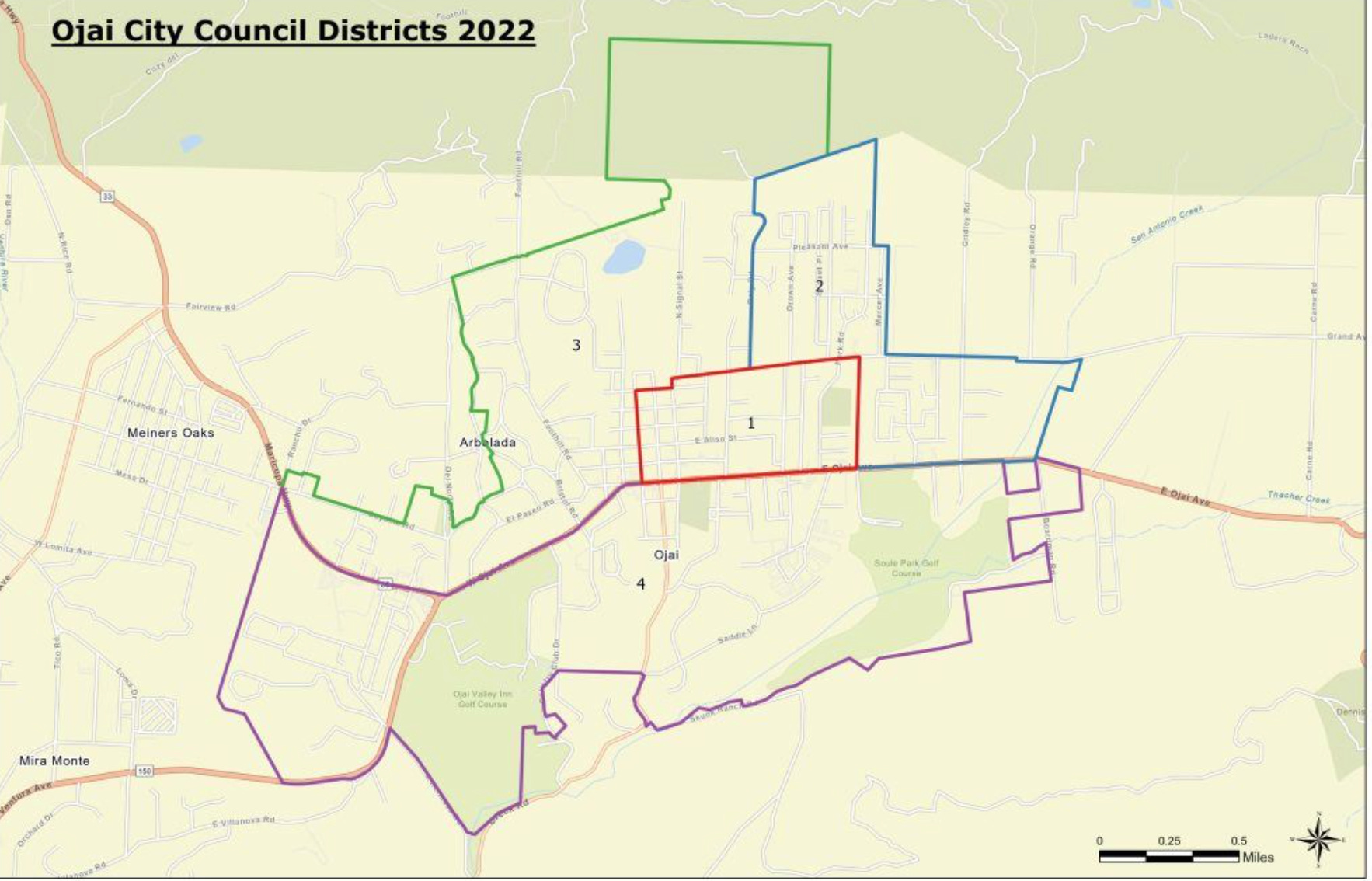
But first! Definitions:
“At-large” indicates that a representative is elected by a full populace — think of the U.S. Senate or the president of the United States… or, the mayor of Ojai!
“District-based” indicates a House of Representatives-style (or, the Ojai City Council, minus the mayor) system in which the elected official represents a smaller district within a nation, state, or municipality.
Got it?!
Our story begins with a 2018 letter from Malibu-based attorney Kevin Shenkman to the Ojai City Council on behalf of the Southwest Voter Registration Education Project.

In the letter, Shenkman alleged that “voting within Ojai is racially polarized, resulting in minority vote dilution.”
Wait, what’s minority vote dilution? Minority, or racial, vote dilution is a tactic by which minority groups are denied an “equal opportunity to elect candidates of their choice.”
What does that look like? Vote dilution can occur in an at-large election system, in which a politically cohesive minority group’s votes are “swamped” by a larger majority, thereby depriving the minority of the ability to elect its chosen candidate. (Think: a Black community in the Jim Crow South.) Another vote-dilution scenario occurs when that same politically cohesive minority group is split across multiple districts — that’s a practice also known as “gerrymandering.”
Quick Constitutional Aside…
The concept of “vote dilution” flows from the Fourteenth and Fifteenth Amendments to the U.S. Constitution, the Voting Rights Act, and the U.S. Supreme Court’s (evolving) interpretations of those statutes. Given that these legal precedents are foundational to American democracy and under attack, let’s review…
The Fourteenth Amendment to our Constitution provided citizenship to formerly enslaved people in 1868.
“All persons born or naturalized in the United States, and subject to the jurisdiction thereof, are citizens of the United States and of the State wherein they reside. No State shall make or enforce any law which shall abridge the privileges or immunities of citizens of the United States; nor shall any State deprive any person of life, liberty, or property, without due process of law; nor deny to any person within its jurisdiction the equal protection of the laws.”
It’s a principle over which Americans fought a Civil War, one that the Trump Administration has openly attacked, and defied.
The Fifteenth Amendment was ratified two years later, in 1870, affirming “the right of citizens of the United States to vote shall not be denied or abridged by the United States or by any State on account of race, color, or previous condition of servitude, and that “the Congress shall have power to enforce this article by appropriate legislation.”
That legislation came in the form of the Voting Rights Act of 1965, which outlawed Jim Crow-era voter suppression tactics aimed at Black voters. Take a look at Section 2 of the law, which basically restates the 15th Amendment:
“No voting qualification or prerequisite to voting or standard, practice, or procedure shall be imposed or applied by any State or political subdivision in a manner which results in a denial or abridgement of the right of any citizen of the United States to vote on account of race or color…”
However, as the Equal Justice Initiative observed, “when states could no longer deny ballots to Black Americans, they used electoral maps and at-large election systems to give minority citizens’ votes no or minimal weight” — voter dilution.
A 1982 amendment to Section 2 of the Voting Rights Act made voter dilution practices easier to challenge in court by conditioning potential violations “not on intent but on the discriminatory effects.”
Translation: you don’t have to prove intentional discrimination — you have to show that discrimination exists in practice. Stay with me, folks — we’re almost there!
California adopted its own Voting Rights Act (CVRA) in 2001. The CVRA “punishes the use of at-large elections, where everyone in a city votes on the same set of candidates,” the San Francisco Chronicle explained in a 2023 investigation. “The idea is that districts give everyone a voice, equalizing power among racial groups.”
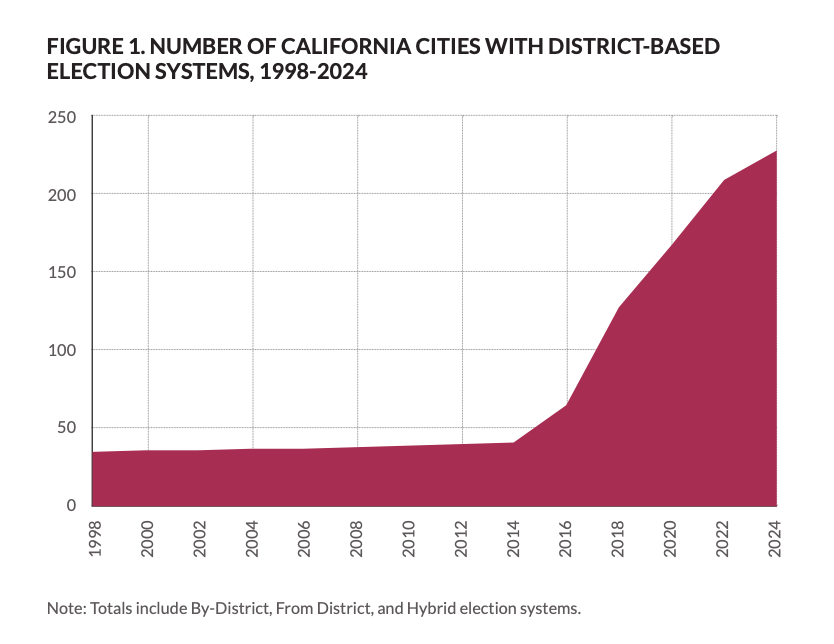
Prior to the CVRA’s passage, only 36 cities in California (8%) used district-based elections; as of 2025, 229 (48%) do.
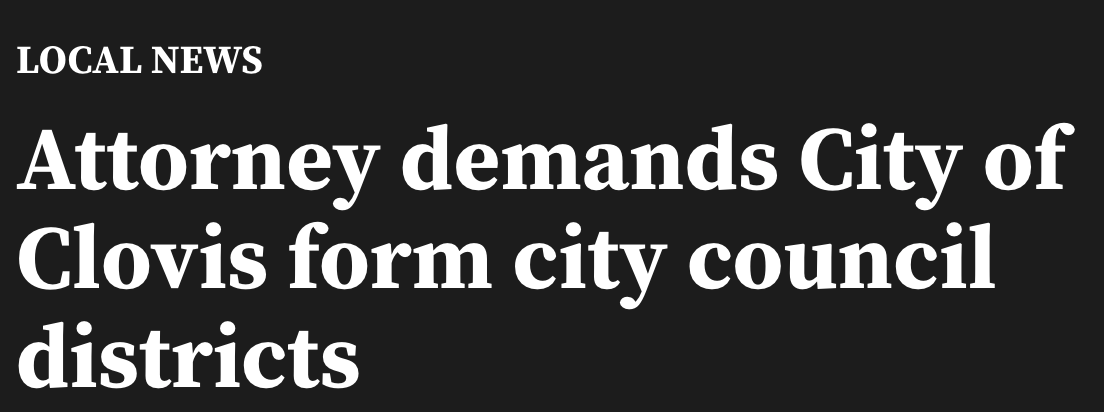
“The law’s first decade was relatively sleepy,” the Chronicle explained, “that all changed in 2012, when [Kevin] Shenkman sued Palmdale, a 150,000-person city north of Los Angeles that was run by white Republicans despite being 69% Latino and Black. When Shenkman beat the city at trial, a judge forced Palmdale to pay him $4.6 million in fees and expenses.”
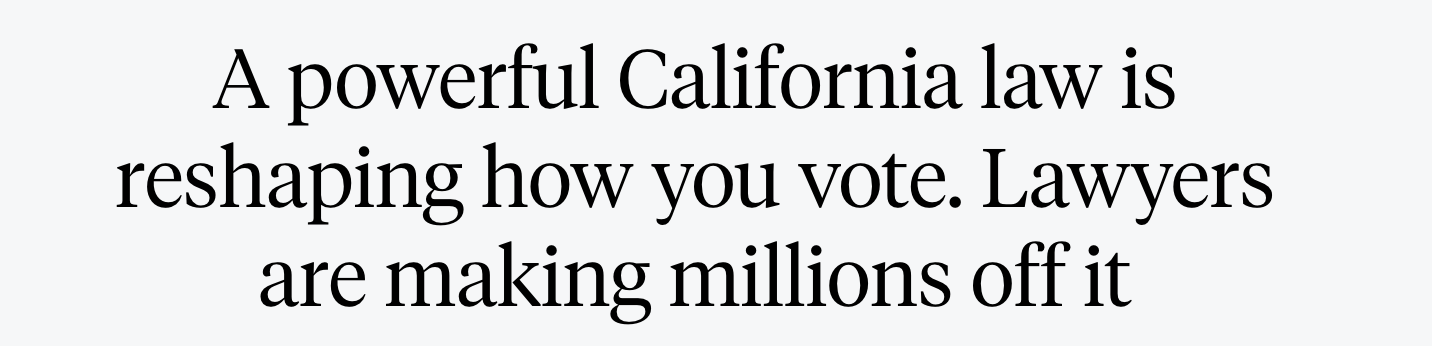
“Shenkman and several colleagues have made more than $15 million from CVRA lawsuits and settlements in the past decade, public records show. And they’ve won so often that local officials have basically stopped fighting back,” the Chronicle found. Folks, this fight is ongoing in communities across the state — not just little Ojai.


That said, at-large large voting is still the norm in small cities like Ojai (pop. 7,600). As of 2025, only 24% of cities with populations under 35,000 have made the switch to district-based elections.
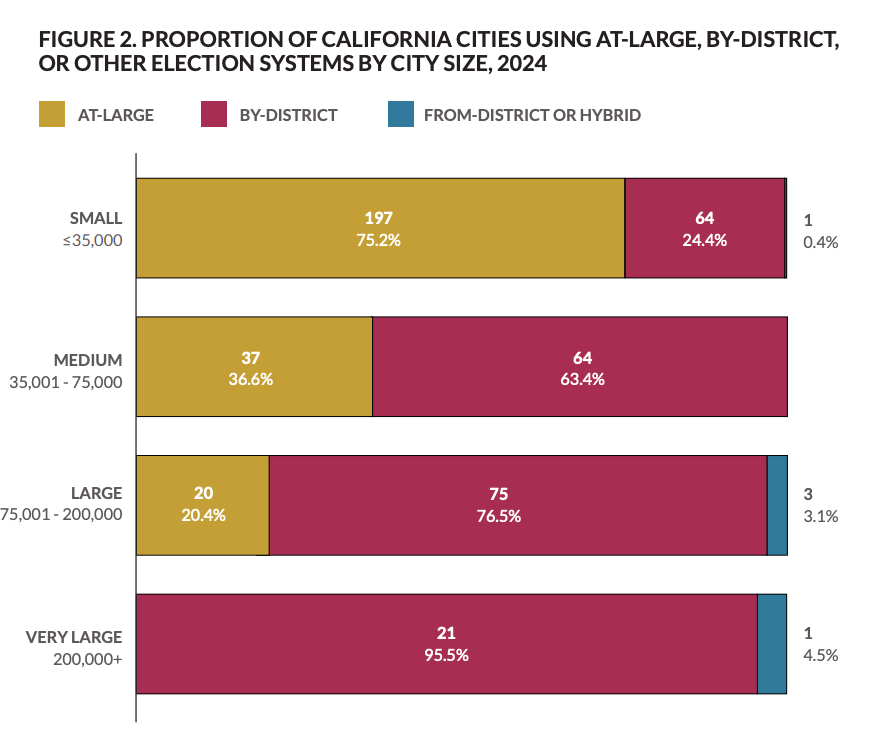
So… have the CVRA and district-based voting successfully reduced racial vote dilution in California? The answer is an unsatisfying “it’s complicated.” In the words of the Chronicle investigation:
“… in many ways, the CVRA is a classic California story: An extraordinary effort to achieve equality has run smack into the staggering complexity of race in this vast and diverse state… In some cities, the CVRA works as intended. All-white boards suddenly become more diverse. Latino and Black candidates run for office and win…. But in many other towns, the CVRA has been ineffective, resulting in boards as white as they were before or sometimes whiter.”
With that, let’s take this story back to Ojai. (And back to 2018).
Attorney Shenkman, in his letter to the Ojai City Council, alleged that “Ojai’s at-large elections violate the California Voting Rights Act,” and argued that “the paucity [scarcity] of Latino candidates to seek election to the Ojai City Council reveals vote dilution.”2
Shenkman “urge[d] Ojai to voluntarily change its at-large system of electing council members”… “Otherwise… we will be forced to seek judicial relief.”
Less than six months after Shenkman’s demand, the Ojai City Council voted 4-1 to shift from at-large to district-based elections.
Former Councilman Bill Weirick cast the lone “no” vote. I’ll note that three of those “yes” votes in favor of district-based elections — Councilmembers Ryan Blatz, Randy Haney, and Suza Francina — have since publicly recanted their decision.
District-based city council elections commenced in Ojai in 2020 — but only in District Four — where Francina won reelection. Shortly thereafter, Francina’s long-term District Four rental was sold. She struggled to find affordable housing in her district for nearly two years, facing calls to step down and a Ventura County Civil Grand Jury investigation (the result of action by political opponents aiming to “get rid of me,” Francina says).


Ojai’s district-based election system, Francina says, “reduces the number of [city council] candidates and discriminates against renters.”
The remaining three city council seats transitioned to district-based elections in 2022. We’ll observe one lasting result of this transition in the forthcoming November elections, when every councilmember but Kim Mang, representing District Four, will be up for reelection. (Mang ran unopposed in 2024 after Francina declined to seek reelection.)
District-based elections are not the only recent change to Ojai elections — voters have made adjustments, too.
Back in 2014, Ojai voters approved Measure A, which created an elected mayor position. Measure B, approved on the same day, set the elected mayor’s term to two years. (Prior to 2014, an appointed mayor position rotated between five councilmembers, all of whom were elected at-large for four-year terms.)
In November 2022 — two years after district-based voting was first implemented — Ojai voters approved Measure M, a run-on sentence of a ballot measure that called for ranked-choice voting for city council candidates “at the discretion of the City Council,” and, “to elect City offices at-large, thereby amending the Ojai Municipal Code to no longer elect City Council members by district, if the City Council implements if starting with the November 2024 general election?”3
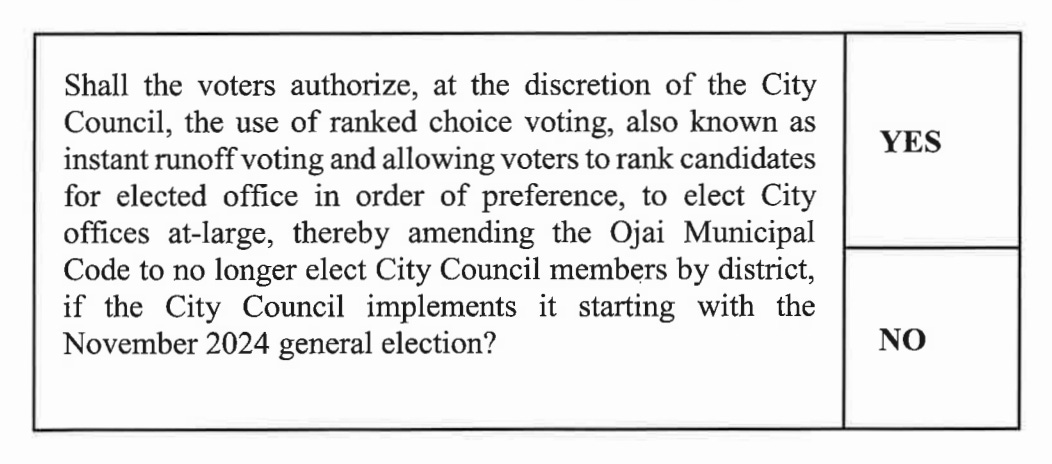
‘Wait a moment,’ you might be thinking, ‘I don’t recall ranked-choice voting on my 2024 ballot…’
That’s because it was never implemented!
As Ojai City Attorney Bethany Burgess explained during the April 28th city council meeting, the state is likely to disallow it.
“Based on research our office has done, ranked choice voting is not feasible under California law for a general law city,” she said.4
Why is that?
“The [California] Secretary of State’s office is going to disapprove any voting system… that is not plurality-based, meaning the person who receives the greatest number of votes is elected,” she said. There’s also the issue that Measure M “arguably required that [it] would need to be implemented starting with the November 2024 general election.”
Oops.
This, my friends, brings us approximately to the present, in which Ojai has a hybrid elections system. Ojai Mayor Andy Gilman, who was elected (at-large) in 2024 and is up for reelection in 2026, has consistently advocated for returning to at-large elections for councilmembers. Gilman moved to add the matter to the agenda of a future Ojai City Council meeting on March 24th, with support from Councilwoman Leslie Rule. The matter arrived before the Ojai City Council on April 28th. Some locals greeted the potential shift. Others were displeased — and suspicious.
Starchild Weivoda, president of the Ojai Valley Democratic Club, endorsed a return to at-large voting on behalf of the group’s membership.
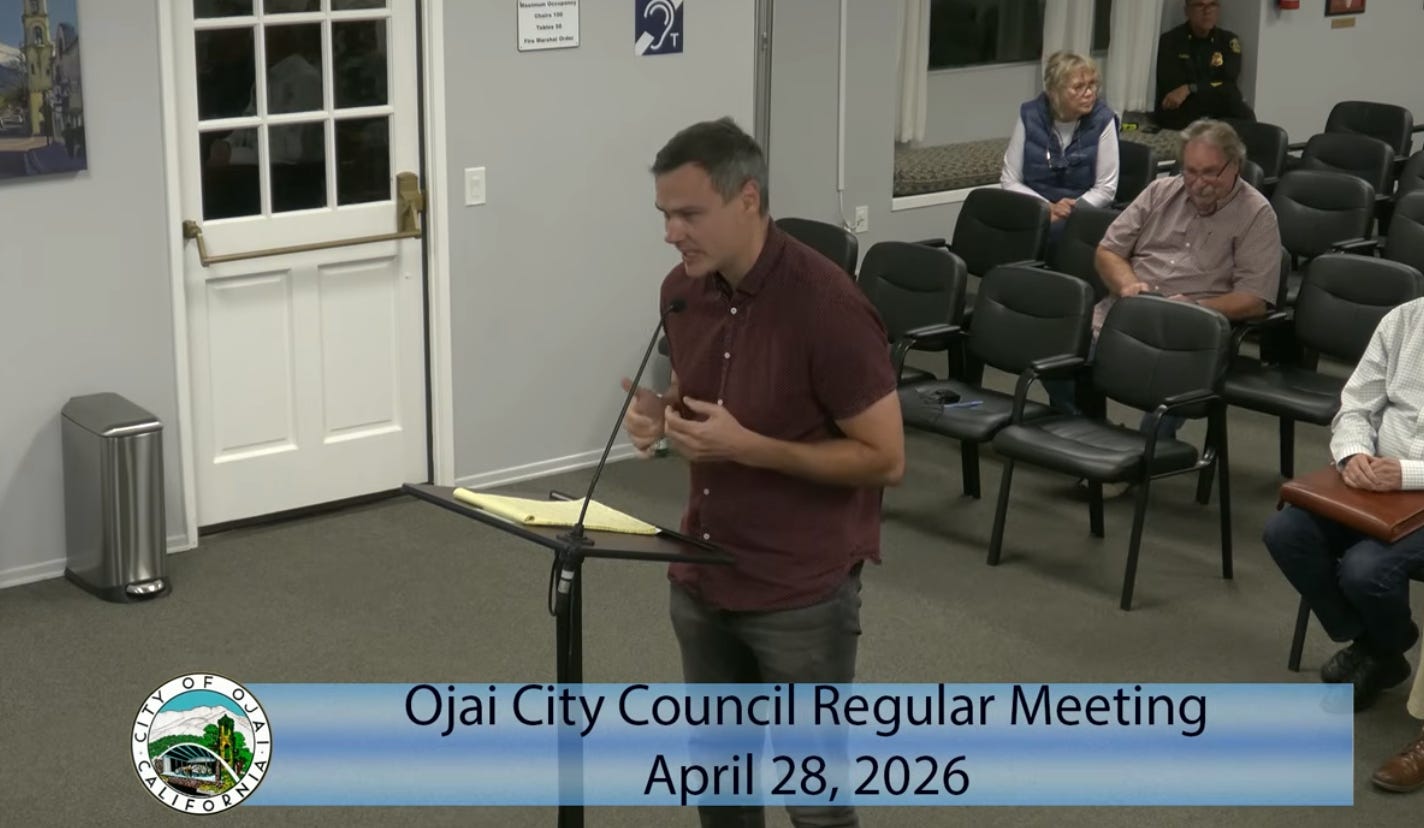
“We’re one city, not four districts. That’s why the electorate voted to return to the at-large voting by referendum,” he said, referring to Measure M. “That’s why the electorate voted overwhelmingly for Mayor Andy Gillman, on the platform of returning to city-wide voting.”
However — the Ojai Valley Democratic Club isn’t the only (Democratic) game in town. The United Democrats of the Ojai Valley are staunchly opposed to the potential shift, arguing that “at-large voting allows a single organized group — with money, coordination, and a specific agenda — to run a slate of candidates and sweep every seat on the city council.” Take a look at this video:
“I say… retain our current district voting in the name of democracy!” United Democrats President Anita Cramm declared.
Cramm and others took issue with the matter’s placement on the agenda.
“This issue came out of nowhere. This came… literally the last minute [of March 24th],” Ojai local Steve Columé commented April 28th.5 After discussing the benefits of district-based voting, Columé shifted his attention to the Ojai Valley Democratic Club, led by Weivoda. “The [Ojai Valley Democratic Club] was nearly defunct,” Columé said. “It was gone for summer, fall, and winter, and all of a sudden, came back again last Sunday to now send in a whole group of letters.”6
Weivoda was seated immediately behind Columé, making this gesture: 🤷♂️.
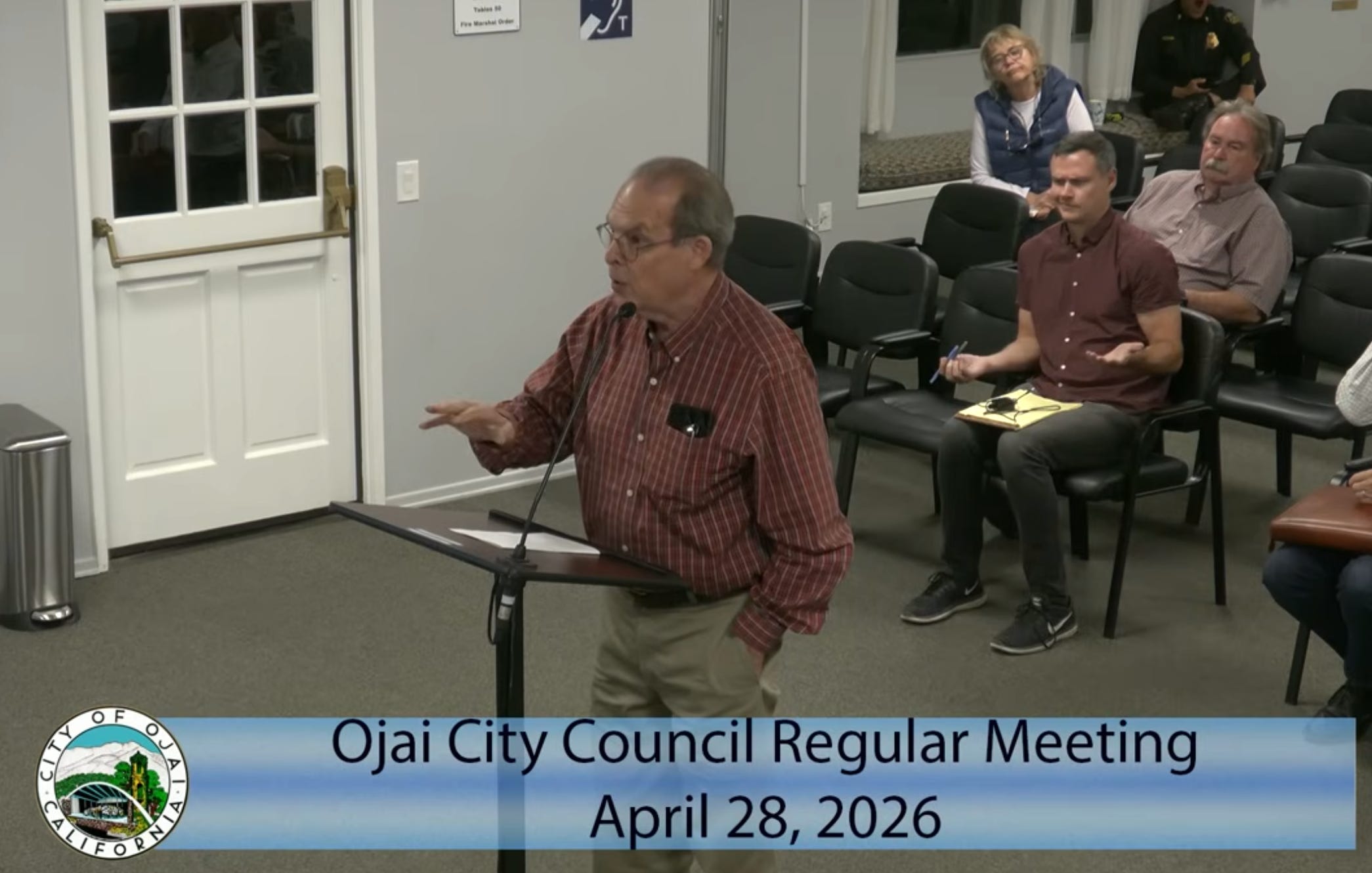
“My real fear,” Columé continued, “is that this effort is a power play to eliminate the districts that we have now — that are in fact working — and to replace it with the potential of there being big money efforts at setting up slates and being able to buy an election in the City of Ojai … I don’t want to say that I’m a conspiracy theorist, but I see a conspiracy here.”
Gilman responded directly.
“To me, it was the number one issue in running for mayor [was] ‘can we go back to the at-large voting?’ So it’s not out of the blue. It was the number one thing that people brought up. And I’m a middle class guy. I fund my own campaign, so no big slate funding me, pal.”
Councilman Andy Whitman pushed back, echoing Colume’s comments.
“I don’t see a reason for doing this other than to put a slate up that you can control. Which has been the goal as stated by the former chair of the Ojai Democratic Club, to control the city council,” Whitman said, looking at Gilman: “And they campaigned heavily for you.”
The Council eventually voted 3-2 (Gilman, Lang, and Rule formed the majority) to commission a demographic study to evaluate Shenkman’s allegation: Is there racial polarization and minority vote dilution in Ojai elections?
That answer arrived at the Ojai City Council one month later, in the form of Doug Johnson, President of the National Demographics Corporation.7
The Council received Johnson’s data-rich demographic report8 on the City of Ojai’s electorate seated around a notable new piece of furniture: a new $47,800 custom-built dais.
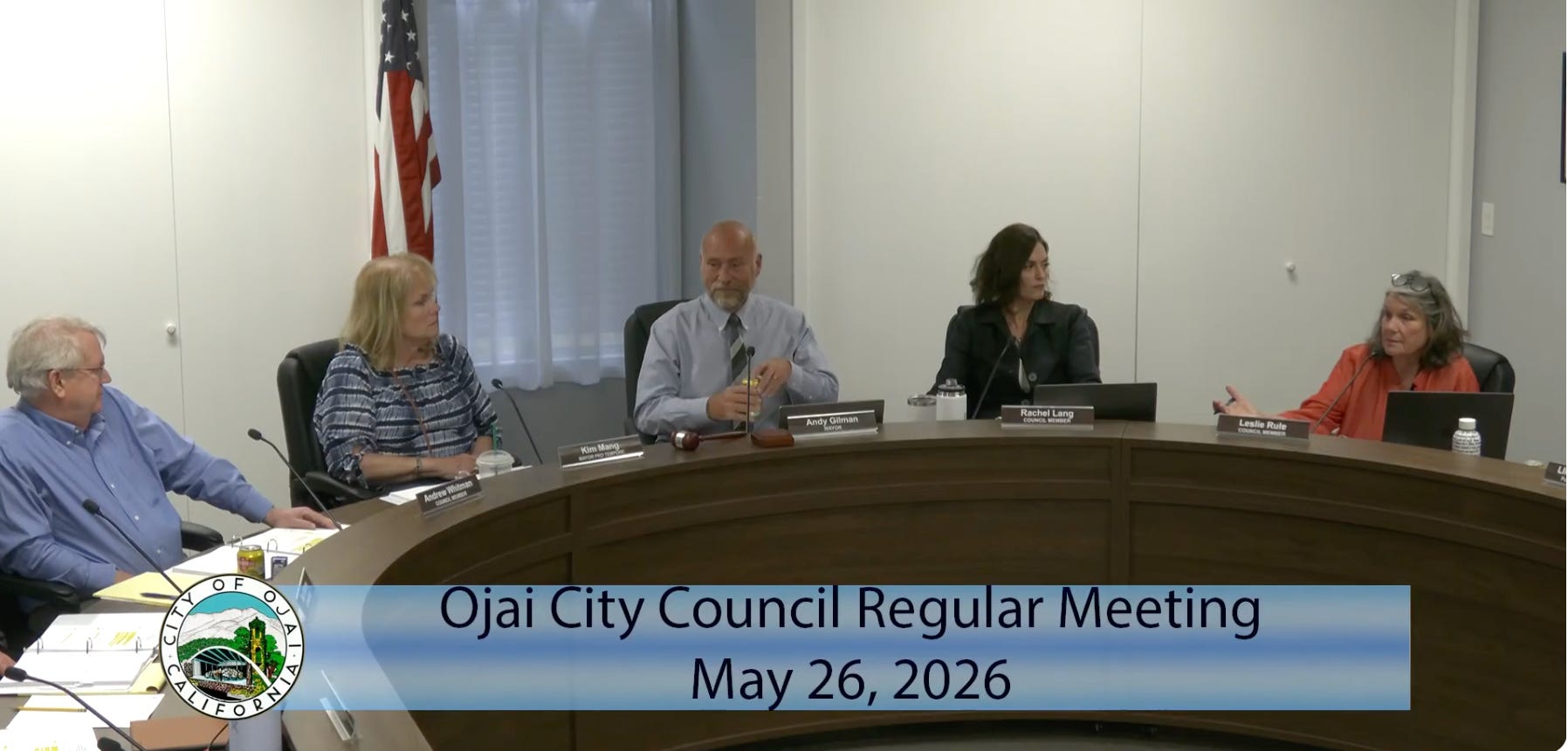
Enough about the dais — here’s Johnson’s bottom line:
“[It’s] pretty safe to say that this does not show polarization,” Johnson reported,9 concluding, “I hopefully have shown as much as can be shown in this very, very gray world10, the switch to by-district voting has not improved Latinos’ ability to elect their preferred candidates, but it does of course prevent Latinos and all voters from voting for the whole Council.”
Notable (and non-essential) bits of data, via the Doug Johnson and the National Demographics Corporation
“As of November 2024, the City of Ojai has 5,455 registered voters, 85% of whom are ‘Non-Hispanic White,’ and 13% are Latino.
“Even in the most-Latino district… [District 1] among voters casting ballots, Non-Hispanic White voters outnumber Latino voters five to one.”
Averages across 4 districts:
Population: 1,913
Registered voters: 1,364
2024 voters (presidential election): 1,130
2022 voters (midterm election): 951
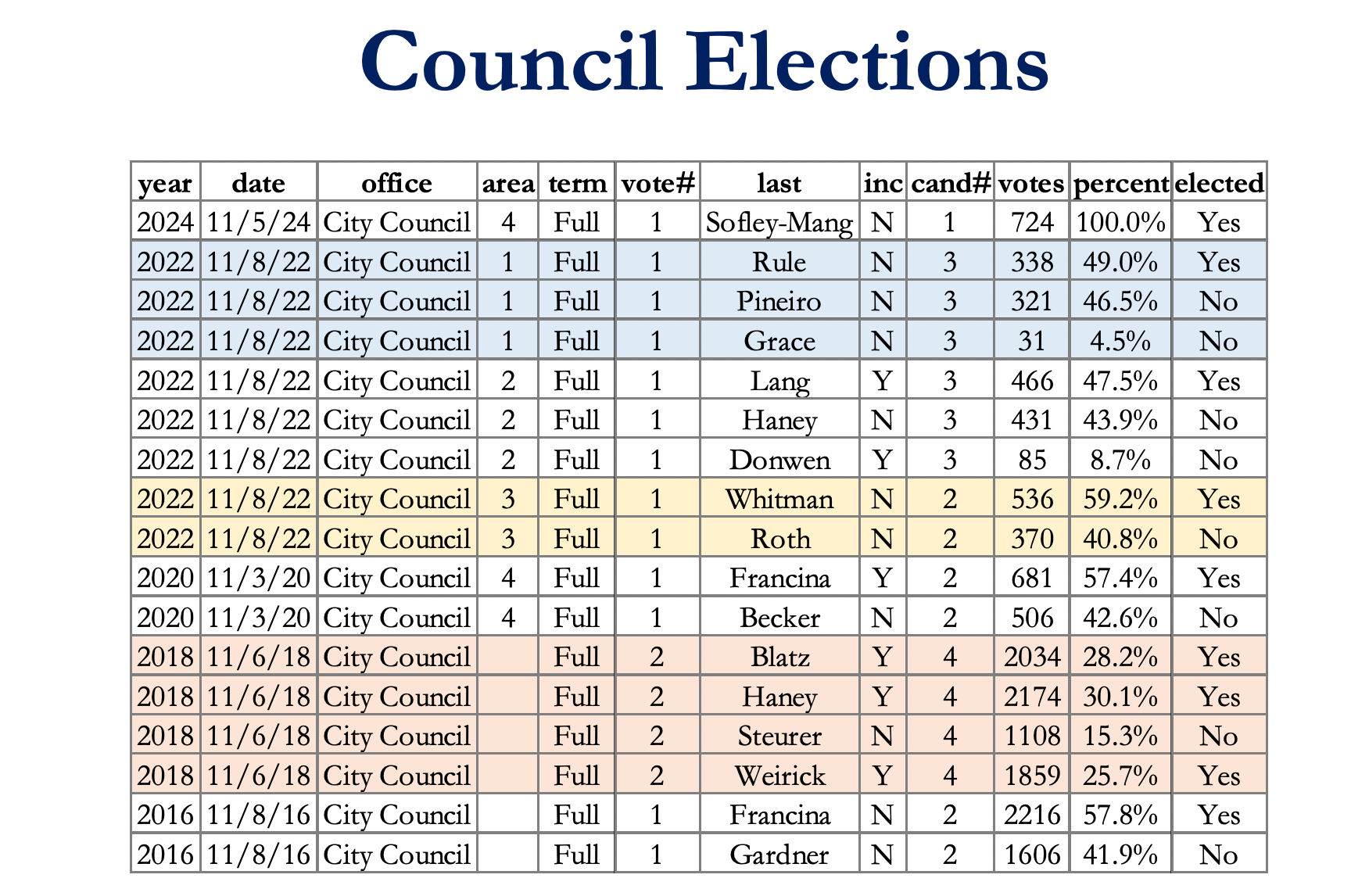
Despite Johnson’s findings, a switch from district-based to at-large elections would very likely trigger a CVRA lawsuit from Shenkman, Burgess said, noting that Ojai would be the first California city to make the move.
“I had a phone call with [Shenkman]. And without saying ‘I will sue the City of Ojai,’ he left me with the impression that litigation would be likely, that we should at least expect a formal threat of litigation,” she reported, adding, “the other big thing I would note is that there’s a perspective in California that if one city makes a move to at-large voting, that other cities will follow.”
There’s one final however here, folks — and it’s a big one. A recent U.S. Supreme Court decision, according to Justice Elena Kagan, “renders Section 2 [of the Voting Rights Act] all but a dead letter.” Recall: it was a 1982 amendment to Section 2 that made voter dilution cases easier to prove in court by requiring evidence of discriminatory effects rather than discriminatory intent.
Louisiana v. Callais
This, my friends, is the story of Louisiana v. Callais, a landmark voting rights case that may determine the future of the California Voting Rights Act.
Journey with me to Louisiana, where Black voters comprise one-third of the state’s population (that’s according to the 2020 Census).11 Louisiana’s 2022 congressional district map, however, included only one majority-Black congressional district, out of six districts total. A group of Black voters took that disparity to court, arguing that the map violated the Voting Rights Act by way of racial vote dilution.
In late 2023, a U.S. District Court judge sided with the plaintiffs and ordered the state legislature to plan for “an additional majority-Black congressional district.” They enacted a congressional map with a second majority-Black congressional district in 2024.
Shortly thereafter, a group of “non-African American” voters challenged that map in court as a “racial gerrymander,” and argued that it was they who were being racially discriminated against.
Indeed, another court found that the redrawn map “violates the Equal Protection Clause” of the Constitution. So whose rights are being violated here? The matter reached the Supreme Court in 2025, and the public received its 6-3 decision in favor of the plaintiffs on April 29, 2026. In the Supreme Court’s view, Louisiana’s second Black-majority congressional district represents a violation of the “non-African American” plaintiffs’ rights.
The Court’s majority opinion was authored by Justice Samuel Alito:
“Section 2 of the Voting Rights Act of 1965… was designed to enforce the Constitution — not collide with it. Unfortunately, lower courts have sometimes applied this Court’s precedents in a way that forces States to engage in the very race-based discrimination that the Constitution forbids.”
Alito continued, “The Fifteenth Amendment, which the Voting Rights Act enforces, ‘is not designed to punish for the past’ but works ‘to ensure a better future.’ The focus of [Section 2] must therefore be on ‘current conditions,’ not on ‘decades-old data relevant to decades-old problems.’12 And none of the historical evidence presented by plaintiffs came close to showing an objective likelihood that the State’s challenged map was the result of intentional racial discrimination… In sum, because the Voting Rights Act did not require Louisiana to create an additional majority-minority district, no compelling interest justified the State’s use of race… That map is an unconstitutional gerrymander, and its use would violate the plaintiffs’ constitutional rights.”
Justice Kagan, as referenced above, views the decision as one in a series of attacks on the Voting Rights Act. Kagan wrote in her dissent:
“The Voting Rights Act is—or, now more accurately, was — ‘one of the most consequential, efficacious, and amply justified exercises of federal legislative power in our Nation’s history.’ It was born of the literal blood of Union soldiers and civil rights marchers. It ushered in awe-inspiring change, bringing this Nation closer to fulfilling the ideals of democracy and racial equality. And it has been repeatedly, and overwhelmingly, reauthorized by the people’s representatives in Congress. Only they have the right to say it is no longer needed — not the Members of this Court. I dissent, then, from this latest chapter in the majority’s now-completed demolition of the Voting Rights Act… The point is not to deliver a eulogy for the law—though, in truth, the Court’s step-by-step slaying of voting rights now makes one appropriate.”
Kagan continued, “the majority now demands that vote-dilution plaintiffs muster proof of racially discriminatory motive.” She observed, “it is the rare legislature, as the history of voting discrimination shows, that cannot camouflage racial targeting with race-neutral justifications.”
Shall we take this story back to Ojai?
Let’s travel back to the May 26, 2026 city council meeting, during which the Council considered Johnson’s demographic findings in the context of a potential shift (back) to at-large voting. City Attorney Burgess acknowledged the Supreme Court decision’s potential impact:
“The reality is that that decision likely calls into question the validity of the California Voting Rights Act…” she said.
Following Johnson’s presentation, which inspired one councilmember to awkwardly misidentify a former council candidate’s ethnicity, it was time for the public to have their say. And this was a battle of the Ojai Valley Democratic Club vs. the United Democrats of the Ojai Valley.
(I will note that only the United Democrats hold a charter with the Ventura County Democratic Party — “the VC Dems hold that the Ojai Valley is well served by the United Democrats of the Ojai Valley,” a representative said.)
Darlene Kilgore, treasurer of the United Democrats of the Ojai Valley, read a resolution passed by her group’s membership, “oppos[ing] any resolutions coming from any other Democratic club or elected officials to remove the existing district voting areas prior to the November 3, 2026 election,” and adopting the California Democratic Party’s official position on the matter.13 Kilgore argued that the shift to at-large voting could increase local campaign costs and leave the city open to Shenkman’s lawsuit. The opposing Democrats, led by Weivoda, continued their advocacy for at-large voting.
Former Councilman Randy Haney took to the podium to recant his own 2018 vote in favor of district-based elections.
“Five of us lived in fear of, ‘Oh my God, we were gonna lose our shirts to [Shenkman],” Haney said, getting increasingly animated as he spoke. (Please recall that Haney is a former Nordhoff football coach.)
Why does this guy pick on little cities? (Coach) Haney asked rhetorically, referring to Shenkman. “Cause little cities cave. Cause little cities don’t have the resources. Cause little cities live in fear. This community doesn’t live in fear. Ask yourself that: Do you live in fear? Are you afraid what that guy’s gonna do?”
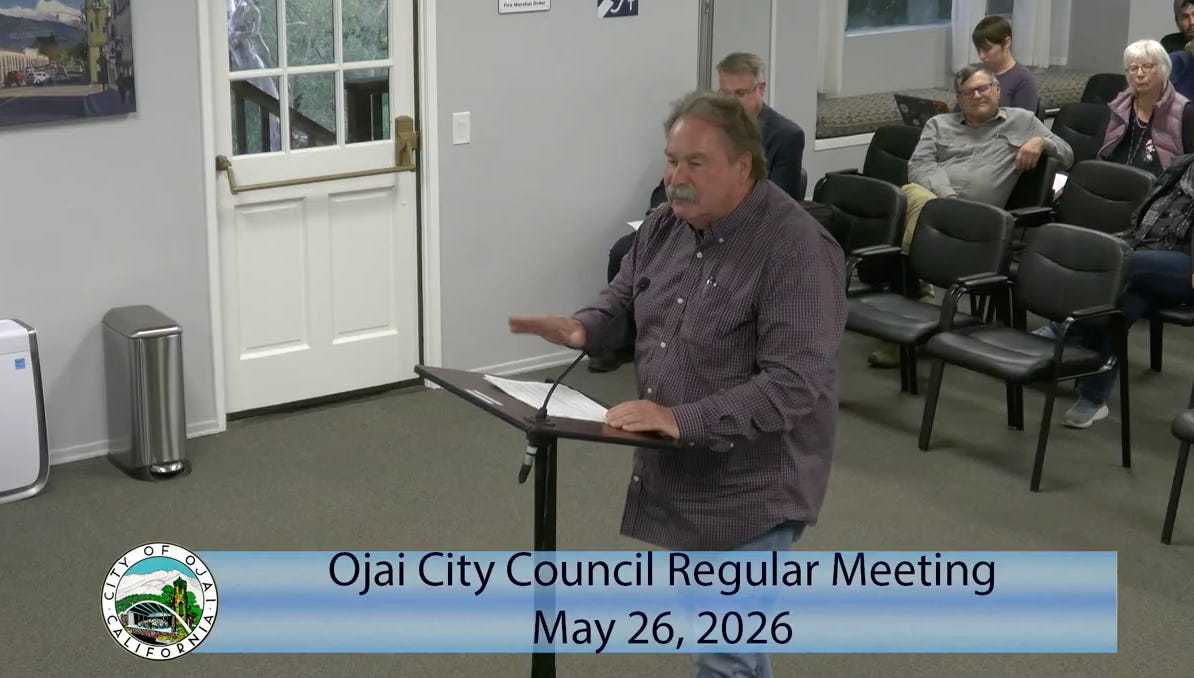
Mayor Andy Gilman chimed in to remind Haney he didn’t have to yell.
“We made a mistake. I’m raising my hand. I made a mistake. I made a decision completely out of fear and lack of information,” Haney concluded. “Don’t go down that path.”
Heidi Whitman — wife of Councilman Andy Whitman — invoked the recent Supreme Court decision and urged the Council, “not to be the first to go backwards on voting rights in Ventura County or in California.”
Local Chelsea Sutula chimed in with a question for the Council that remains unanswered: “I… want to ask if we’ve reached out to actually any minority groups directly to ask them how they feel? I feel like this is a bunch of white people talking about it and two Democratic clubs going at it, which I find really interesting.”
Indeed.
I’ll take the opportunity to insert an observation: Ojai’s California Voting Rights Act-inspired debate isn’t really about racial voter dilution. It’s about litigation, public perception, and power in a time of severely degraded public trust.
Anyways — the Council took a short break following the long and — at times — emotional public comment period. One audience member approached me to report she’d called her own representative on the Council a “piece of shit” due to their position on the issue.14
When the Council came back from its break (now facing a substantially smaller audience), Councilwoman Rachel Lang found herself in a familiar position: the swing vote amongst four colleagues.
“There’s a lot at stake for Ojai of being the first city to go back to at-large voting, especially right now,” Lang explained, continuing, “I think that there are so many benefits to going back to at-large, but the law is really unsettled and for now it’s my perspective that this is not in the city’s best interest to expose [itself] to litigation. I’m not making this decision out of fear. I’m making this decision out of being pragmatic with the city’s budgetary concerns and also for [not] putting ourselves in the line of fire for voting rights activists all over the country…”
With Lang’s comments, it became clear that Gilman and Rule (and the Ojai Valley Democratic Club) were in the minority on this one. No vote was taken, and Councilman Whitman suggested that the “best way” to decide the matter would be with a citizen-led referendum.
So what does this all mean?
Ojai’s 2026 elections will proceed with our present “mixed” system. Voters will have the opportunity to choose a mayor, and residents of Districts One, Two, and Three will vote for their councilmember (currently represented by Rule, Lang, and Whitman, respectively).
The national battle over constitutional rights continues as I type. On June 30, 2026, the U.S. Supreme Court ruled 5-4 to overturn President Trump’s executive order to end birthright citizenship.

The majority in favor of upholding birthright citizenship (and, it seems, the 14th Amendment) includes conservative Chief Justice John Roberts and Justice Amy Coney Barrett, alongside liberal Justices Sonia Sotomayor, Ketanji Brown Jackson, and Kagan. Conservative Justices Brett Kavanaugh, Neil Gorsuch, Clarence Thomas, and Alito were in the minority.
That’s not the only relevant decision SCOTUS shared June 30th. “By a vote of 6-3, the justices struck down a federal law that limited the amount of money that political parties can spend in coordination with a candidate for office,” ScotusBlog reported.
The majority, represented by Justice Kavanaugh, argued their decision protects freedom of speech under the First Amendment. The dissenting justices, represented by Kagan, said the ruling would result in a U.S. legal system “increasingly unable to stop political corruption, and thus to preserve our institutions’ democratic legitimacy.”
Let’s swing back to Ojai and recall some Democrats’ warning of a well-funded “slate” of candidates. It seems to me an extremely valid concern, especially given the recent Supreme Court decision. That said, I don’t see at-large elections as inherently more corruptible with cash than district-based ones. (As always, I invite folks to argue with me in the comments.)
Before closing, I want to encourage folks to make sure you are registered to vote. November 3rd will be here soon, and we have choices to make.
If you wish to support this kind of storytelling, please consider subscribing or donating. (Send a note to andra.belknap@gmail.com for a free trial subscription.)
Why I attend City Council meetings, in a nutshell.
Ojai elected a Latino councilman at-large in 2012, who was appointed mayor in 2014. That same candidate lost the at-large mayoral race in 2016. A Latina candidate unsuccessfully ran to represent City Council District One in 2022 and the mayor position in 2024.
Former Ojai Councilman Bill Weirick provided more context around the ballot measure: “the reason for Measure M grew out of a language in [legal] deliberations… that specifically said that there may be alternatives to [district-based elections] to achieving compliance with the California [Voting Rights Act] and they specifically called out rank choice voting as being one option. That’s why Measure M was put on the ballot.”
There are actually two legal structures for managing a city in California: general law or charter. Ojai has no charter, so we operate by “general law.”
I’ll note that councilmembers have the (agendized) opportunity to suggest new agenda items at the end of each city council meeting.
I’ll note that there were three written public comments submitted prior to the meeting in favor of at-large elections, including Weivoda’s.
Johnson and colleagues helped Ojai through the districting process back in 2018.
See item 7 in the linked agenda for Johnson’s powerpoint presentation.
See item 7 in the linked agenda for Johnson’s powerpoint presentation.
Meaning: not black and white.
One function of the Census is that it informs congressional districts — how many a state holds, and the boundaries.
Seems to me he’s referring to institutional racism as a thing of the past — or perhaps he’s specifically referring to racialized voter suppression. Either way, it’s remarkable.
The California Democrats, “encourage the replacement of at-large election methods with the adoption of by-district and/or alternative voting methods when it maintains the spirit of the California Voting Rights Act.”
Not a great persuasion tactic.
I have a feeling the Local Hero audience would appreciate this podcast: https://podcasts.apple.com/us/podcast/scene-on-radio/id1036276968?i=1000769825392
All about the threats to local journalism. I’m thankful for Andra working to create rigorous Ojai journalism and combat the desertification!